Some account of the last yellow fever epidemic of British Guiana / by Daniel Blair, surgeon general of British Guiana ; edited by John Davy, inspector general of army hospitals, etc.
- Blair, Daniel.
- Date:
- 1852
Licence: Public Domain Mark
Credit: Some account of the last yellow fever epidemic of British Guiana / by Daniel Blair, surgeon general of British Guiana ; edited by John Davy, inspector general of army hospitals, etc. Source: Wellcome Collection.
Provider: This material has been provided by King’s College London. The original may be consulted at King’s College London.
28/290 (page 6)
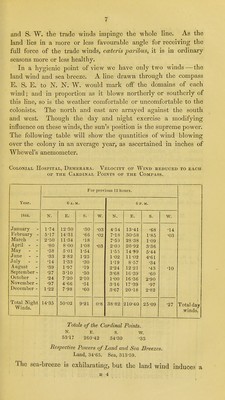
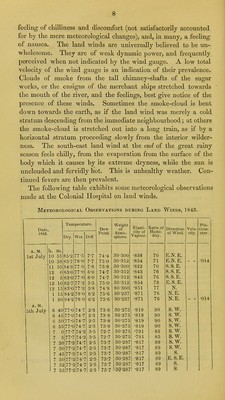
![half-rotten stems and roots, probably the vestiges of some pre- vious cultivation projecting several feet above the level of the swamp. On its sea margin a forest of young corrudas, (Avir cennia nitida et tormentosa) and other trees which delight in a brackish humid soil, was springing up. The marsh was tufted with a coarse grass, under whose half-withered leaves myriads of insects were sheltered. Innumerable crabs burrowed through- out.* Fragments of drift wood, bones, dead spawn, dried rao- lusca, and small fish left by the retreat of the tide, were scattered profusely over the surface. Near to the public road were small gullies, communicating apparently with the jungle, lined with cryptogamic plants, and containing frothy putrid-looking water, f Within the trenches aquatic larvaj and exuvi^ abounded, and over them clouds of mosquitos and sand flies. Such was the condition of the neighbourhood of the Military Grounds during the epidemic. These particulars were noted by the author more especially in 1840, in consequence of a reference being made to him by his Excellency the Governor, with a view to reply to a dispatch from the E-ight Honourable the Secretary at War, re- garding the question why in a few months sixty-nine per cent, of all the white troops had perished. In close proximity and to leeward of the marsh stood the Military Hospital. It is said that almost every case admitted to this hospital during the epi- demic became yellow fever, no matter what the ailment on ad- mission ; and it ultimately became such a terror to the soldiers, that the utmost difficulty was experienced in persuading them to enter it when sick. | WEATHER OP BRITISH GUIANA. The two most important meteorological elements here are the ' wind and the rain. The inhabited sea-coast lying nearly N. E. * [ A species common throughout the West Indies, in loose sandy soils, bordering on the sea-shore. (Cancer Ruricola Lin., Gecarcinus Ruricola ? Lat.)]—Ed. 1 [Perhaps this appearance was deceptive; commonly in such situations the air disengaged, producing the froth, is oxygen, from the decomposition of carbonic acid by the cryptogamia under the influence of light.]—Ed. J fin illustration of the above remark it may be mentioned that Dr. Ilackett, now Deputy Inspector Genei-al of Hospitals, then on duty in Georgetown, when attacked by the prevailing fever, heroically bad himself removed from his house and family to the Military Hospital, with the hope of overcoming the dread towards it entertained by the soldiers.] — Ed.](https://iiif.wellcomecollection.org/image/b2129799x_0028.jp2/full/800%2C/0/default.jpg)