Some account of the last yellow fever epidemic of British Guiana / by Daniel Blair, surgeon general of British Guiana ; edited by John Davy, inspector general of army hospitals, etc.
- Blair, Daniel.
- Date:
- 1852
Licence: Public Domain Mark
Credit: Some account of the last yellow fever epidemic of British Guiana / by Daniel Blair, surgeon general of British Guiana ; edited by John Davy, inspector general of army hospitals, etc. Source: Wellcome Collection.
Provider: This material has been provided by King’s College London. The original may be consulted at King’s College London.
34/290 (page 12)
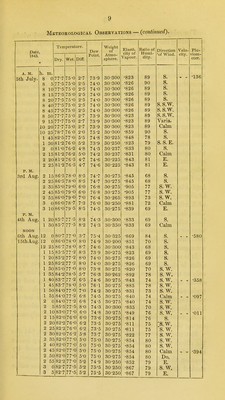
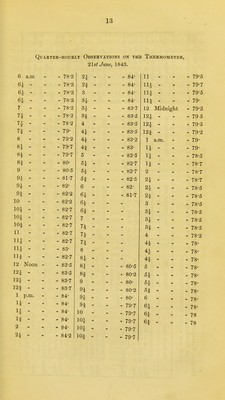
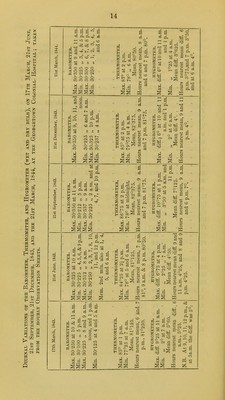
![may pour down the same quantity of rain, but the air feels damp and foggy afterwards. The former probably come from a high and cool altitude,—the latter from the nearest vapours. The daily fall of rain for two years, with the quantity reabsorbed by the air, from a plain impermeable surface, will be found in the Tables of the third division. The coolest and hottest weather follow the sun's position; the former being generally in February and the latter in July and August. The intense heat which should arise from the sun's double path over our zenith between the months of March and September is mitigated by the canopy of thick clouds and by the rains at the middle period of the year, as well as by the favourable aspect of our seaboard. Though the climate, in regard to heat, is very uniform, small differences of temperature in the weather produce a marked effect on the comfort of the colonists. Coldness and chilliness of the wind is sometimes complained of, and the complainant is jocosely recommended to emigrate further south. A thermal and chiemal curve (if the latter be possible here), and a curve of diurnal variations, may be formed from the meteorological obser- vations recorded in the third division. To show, however, the mild gradations of temperature during the day, and the maxima and minima of some other meteorological elements in the climate of British Guiana at Georgetown, I here subjoin a day of quarter-hourly observations (although imperfect) on the ther- mometer, and the result of four days of hourly observations on the barometer, thermometer, and hygrometer. [See Tables, pp. 13, 14.]](https://iiif.wellcomecollection.org/image/b2129799x_0034.jp2/full/800%2C/0/default.jpg)