Some account of the last yellow fever epidemic of British Guiana / by Daniel Blair, surgeon general of British Guiana ; edited by John Davy, inspector general of army hospitals, etc.
- Blair, Daniel.
- Date:
- 1852
Licence: Public Domain Mark
Credit: Some account of the last yellow fever epidemic of British Guiana / by Daniel Blair, surgeon general of British Guiana ; edited by John Davy, inspector general of army hospitals, etc. Source: Wellcome Collection.
Provider: This material has been provided by King’s College London. The original may be consulted at King’s College London.
39/290 (page 17)
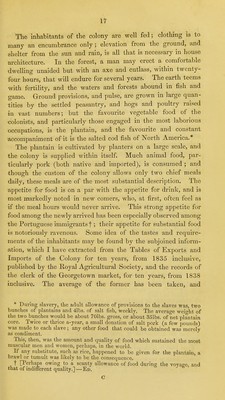
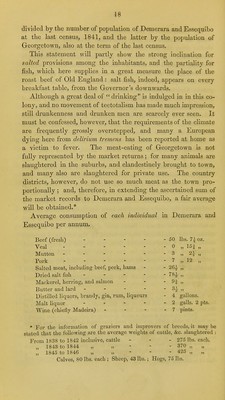
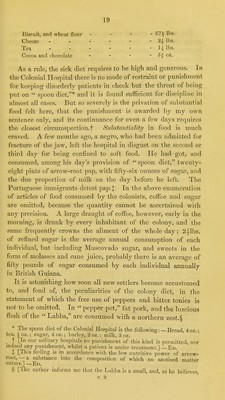
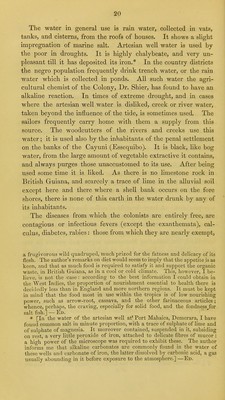
![The inhabitants of the colony are well fed; clothing is to many an encumbrance only ; elevation from the ground, and shelter from the sun and rain, is all that is necessary in house architecture. In the forest, a man may erect a comfortable dwelling unaided but with an axe and cutlass, within twenty- four hours, that will endure for several years. The earth teems with fertility, and the waters and forests abound in fish and game. Ground provisions, and pulse, are grown in large quan- tities by the settled peasantry, and hogs and poultry raised in vast numbers; but the favourite vegetable food of the colonists, and particularly those engaged in the most laborious occupations, is the plantain, and the favourite and constant accompaniment of it is the salted cod fish of North America.* The plantain is cultivated by planters on a large scale, and the colony is supplied within itself. Much animal food, par- ticularly pork (both native and imported), is consumed ; and though the custom of the colony allows only two chief meals daily, these meals are of the most substantial description. The appetite for food is on a par with the appetite for drink, and is most markedly noted in new comers, who, at first, often feel as if the meal hours would never arrive. This strong appetite for food among the newly arrived has been especially observed among the Portuguese immigrants f ; their appetite for substantial food is notoriously ravenous. Some idea of the tastes and require- ments of the inhabitants may be found by the subjoined inform- ation, which I have extracted from the Tables of Exports and Imports of the Colony for ten years, from 1835 inclusive, published by the Royal Agricultural Society, and the records of the clerk of the Georgetown market, for ten years, from 1838 inclusive. The average of the former has been taken, and * During slavery, the adult allowance of provisions to the slaves was, two bunches of plantains and 4lbs. of salt fish, weekly. The average weifht of the two bunches would be about 70lbs. gross, or about 351bs. of net plantain core. Twice or thrice a-year, a small donation of salt pork (a few pounds) was made to each slave; any other food that could be obtained was merely as condiment. This, then, was the amount and quality of food which sustained the most muscular men and women, perhaps, in the world. If any substitute, such as rice, happened to be given for the plantain, a brawl or tumult was likely to be the consequence. t [Perhaps owing to a scanty allowance of food during the voyage, and that of indifferent quality.] — Ed. C](https://iiif.wellcomecollection.org/image/b2129799x_0039.jp2/full/800%2C/0/default.jpg)