Some account of the last yellow fever epidemic of British Guiana / by Daniel Blair, surgeon general of British Guiana ; edited by John Davy, inspector general of army hospitals, etc.
- Blair, Daniel.
- Date:
- 1852
Licence: Public Domain Mark
Credit: Some account of the last yellow fever epidemic of British Guiana / by Daniel Blair, surgeon general of British Guiana ; edited by John Davy, inspector general of army hospitals, etc. Source: Wellcome Collection.
Provider: This material has been provided by King’s College London. The original may be consulted at King’s College London.
88/290 (page 66)
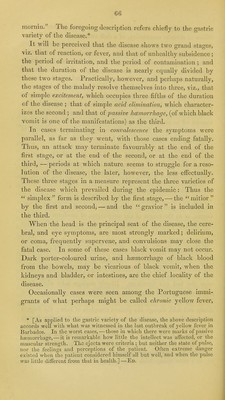
![G6 mornin. The foregoing description refers chiefly to the gastric variety of the disease.* It will be perceived that the disease shows two grand stages, viz. that of reaction, or fever, and that of unhealthy subsidence ; the period of irritation, and tlie period of contamination ; and that the duration of the disease is nearly equally divided by these two stages. Practically, however, and perhaps naturally, the stages of the malady resolve themselves into three, viz., that of simple excitement, which occupies three fifths of the duration of the disease ; that of simple acid elimination, which character- izes the second ; and that passive /mmorrhat/e, (of which black vomit is one of the manifestations) as the third. In cases terminating in convalescence the symptoms were parallel, as far as they went, with those cases ending fatally. Thus, an attack may terminate favourably at the end of the first stage, or at the end of the second, or at the end of the third, — periods at which nature seems to struggle for a reso- lution of the disease, the later, however, the less effectually. These three stages in a measure represent the three varieties of the disease which prevailed during the epidemic: Thus the simplex form Is described by the first stage,— the mitlor by the first and second, — and the gravlor is included In the third. When the head Is the principal seat of the disease, the cere- bral, and eye symptoms, are most strongly marked; delirium, or coma, frequently supervene, and convulsions may close the fatal case. In some of these cases black vomit may not occur. Dark porter-coloured urine, and htemorrhage of black blood from the bowels, may be vicarious of black vomit, when the kidneys and bladder, or intestines, are the chief locality of the disease. Occasionally cases were seen among the Portuguese Immi- grants of what perhaps might be called chronic yellow fever, * [As applied to the gastric variety of tlie disease, the above description accords well with what was witnessed in the last outbreak of 3'ellow fever in Barbados. In the worst cases, — those in which there were marks of passive bajmorrhage, — it is remarkable how little the intellect was affected, or the muscular strength. The ejecta were criteria ; but neither the state ofpul.se, nor the feelings and perceptions of the patient. Often extreme danger existed when the patient considered himself all but well, and when the pulse was little difl'erent from that in health.]—Ed.](https://iiif.wellcomecollection.org/image/b2129799x_0088.jp2/full/800%2C/0/default.jpg)