Aristotle : On the parts of animals / translated, with introduction and notes by W. Ogle.
- Aristotle
- Date:
- 1882
Licence: Public Domain Mark
Credit: Aristotle : On the parts of animals / translated, with introduction and notes by W. Ogle. Source: Wellcome Collection.
167/316 page 119
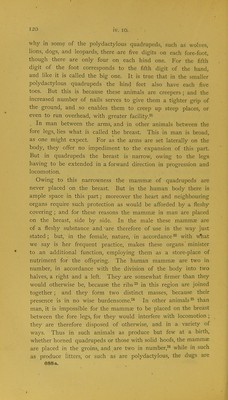
![Such capacity of divergence does not prevent their again con- verging so as to form a single compact body, whereas had the hand been an undivided mass, divergence would have been impossible. Again these parts may be used singly or together, and in various combinations. The joints, moreover, of the fingers are well constructed for prehension and for pressure. One of the digits also, and this not long like the rest but short and thick, is placed laterally. For were it not so placed all prehension would be as impossible, as were there no hand at all. For the pressure of this lateral digit is applied from below upwards, while the rest act from above downwards; an arrangement which is essential, if the grasp is to be firm and hold like a tight clamp. As for the shortness of this lateral digit, the object is to increase its strength, so that it may be able, though but one, to counter- balance its more numerous opponents. Indeed were it long it would be of no use. This is the explanation of its being some- times called the great digit, in spite of its small size ; for without it all the rest would be practically useless. The finger which stands at the other end of the row is small, while the central one of all is long, like the centre oar in a ship. This is rightly so; for in grasping an object, as a workman grasps his tool, it is the central part of the encircling hold which is of the most importance. No less skilfully contrived are the nails. For, while in man th*e serve simply as coverings to protect .the ends of the fingers, in other animals they are also used for active purposes; [and their form in each case is suited to their office.]*® The arms in man and the fore limbs in quadrupeds bend in precisely contrary directions, this difference having reference to the ingestion of food and to the other offices which belong to these parts. For quadrupeds use their anterior limbs as feet in progression, and must therefore have them bent inwards. In such of the quadrupeds indeed as are polydactylous; these fore limbs are at any rate intended not only to serve in locomotion, but also to act as hands. And they are in fact so used, as any one may see. For these animals seize hold of objects, and also repel assailants, with their anterior limbs; whereas quadrupeds with solid hoofs use their hind legs for this latter purpose.*® For their fore limbs are not analogous to the arms and hands of man.®** It is this hand-like office of the anterior limbs which explains](https://iiif.wellcomecollection.org/image/b24864249_0167.jp2/full/800%2C/0/default.jpg)