Aristotle : On the parts of animals / translated, with introduction and notes by W. Ogle.
- Aristotle
- Date:
- 1882
Licence: Public Domain Mark
Credit: Aristotle : On the parts of animals / translated, with introduction and notes by W. Ogle. Source: Wellcome Collection.
303/316 page 255
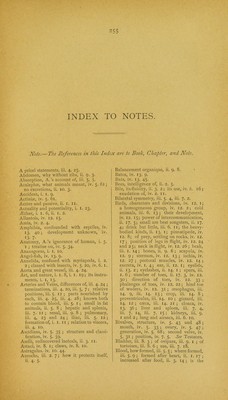
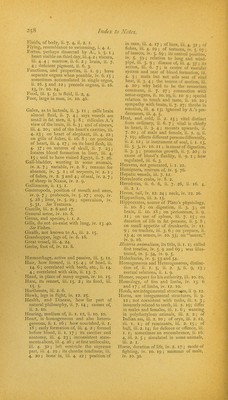
![INDEX TO NOTES. ]^oie.—The References in ihis Index are to Book, Chapter, and Note. A priori statements, iii. 4. 25. Abdomen, why without ribs, ii. 9. 3. Absorption, A.’s account of, iii. S- S- Acalephse, what animals meant, iv. 5. 61; no excretions, ii. 10. 3. Accident, i. 1.9. Actinise, iv. 5. 61. Active and passive, ii. I. ll. Actuality and potentiality, i. i. 23. Aither, i. 1.6, ii. i. 2. Allantois, iv. 12. 15. Amia, iv. 2. 4. Amphibia, confounded with reptiles, iv. 13. 40; development unknown, iv. 13- 7- Anatomy, A.’s ignorance of human, 1. 5. 1 ; treatise on, iv. 5. 34. Anaxagoras, i. i. 10. Angel-fish, iv. 13. 9. Annelida, confused with myriapoda, i. 2. 2 ; classed with insects, iv. 5. 20, iv. 6. i. Aorta and great vessel, iii. 4. 24. Art, and nature, i. l. 8, i. l. 19; its instru- ments, i. I, 13. Arteries and Veins, differences of, iii. 4. 24 ; terminations, iii. 4. 20, iii. 5, 7; relative positions, iii. 5. 12 ; parts nourished by each, iii. 4. 25, iii. 4. 28; known both to contain blood, iii. 5. I ; small in fat animals, ii. 5. 8 ; hepatic and splenic, iii. 7- II ; renal, iii. 9. 8 ; pulmonary, iii. 4, 23 and 24 ; iliac, iii. 5. 12 ; formation of, i. i. ii ; relation to viscera, iii. 4. 10. Ascidians, iv. 5. 35 ; structure and classi- fication, iv. 5. 59. Aselli, rediscovered lacteals, ii. 3. ii. Astaci, iv. 8. i; claws, iv. 8. 10. Astragalus, iv. 10. 44. Aurochs, iii. 2. 7; how it protects itself, Balancement organique, ii. 9. 8. • Batos, iv. 13. 9. Bats, iv. 13. 45. Bees, intelligence of, ii. 2. 5. Bile, its fluidity, ii. 3. 2; its use, iv. 2. 16; exudation of, iv. 2. II. Bilatefal symmetry, iii. 5. 4, iii. 7. 2. Birds, characters and divisions, iv. 12. I; a homogeneous group, iv. 12. 2; cold animals, iii. 6. 13; their development, iv. 12. 15; power of intercommunication, 11. 17. 5; small are best songsters, ii. 17. 4; drink but little, iii. 6. ll; the heavy- bodied kinds, ii. 13. l; pinnatipede, iv. 12. 8; of prey, settling on rocks, iv. 12. 17 ; position of legs in flight, iv. 12. 24 and 25; neck in flight, iv. I2. 26 ; beak, iii. I. 14; bones, ii. 9. 6; scapula, iv. 12. 9 ; sternum, iv. 12. 13 ; ischia, iv. 12. 27 ; pectoral muscles, iv. 12. 14; excreta, iv. l. 4; ear, ii. 12. l; eyelids, ii. 13. 2; eyelashes, ii. 14. l ; spurs, iii. I. 6; number of toes, ii. 17. 3, iv. 12. 30; direction of toes, iv. 12. 33 ; phalanges of toes, iv. 12. 22; hind toe of waders, iv. 12. 31 ; oesophagus, iii. 14. 9, iii. 14. 13; crop, iii. 14. 8 ; proventriculus, iiL 14. 10 ; gizzard, iii. 14. 12 ; cteca, iii. 14. 21 ; cloaca, iv. 13. 36; liver and spleen, iii. 7. 4, iii. 7. 14, iii. 7. 15; kidneys, iii. 9. I and 2; lung and airsacs, iii. 6. 10. Bivalves, structure, iv. 5. 43 and 48; mouth, iv. 5. 33 ; ovary, iv. 5. 47 ; generation, iv. 5. 68; second valve, iv. 5. 31 ; position, iv. 7. 5. See Testacea. Bladder, iii. 8. 3 ; of ovipara, iii. 9. i ; of tortoises, iii. 8. 6 ; use, iii. 7. 18. Blood, how formed, iii. 5. 5 ; where formed, iii. 5-9; formed after heart, ii. I. 17 ;](https://iiif.wellcomecollection.org/image/b24864249_0303.jp2/full/800%2C/0/default.jpg)