Aristotle : On the parts of animals / translated, with introduction and notes by W. Ogle.
- Aristotle
- Date:
- 1882
Licence: Public Domain Mark
Credit: Aristotle : On the parts of animals / translated, with introduction and notes by W. Ogle. Source: Wellcome Collection.
45/316
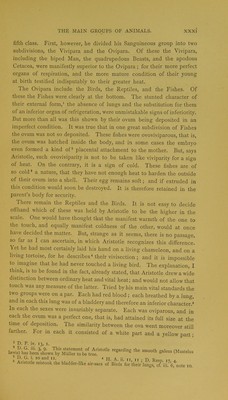
![sexual, Turbinata at the top, and the ‘ sedentarj and asexual Bivalves at the bottom, while the Univalves or limpets, usually fixed but capable of locomotion, would have held the middle place. The greater or less power of locomotion, the presence or absence of the higher senses, the degrees of vital centralization, of which the. number of legs formed a criterion, and the position of the body in regard to its elevation above the ground, would have given to the subdivisions of his Insecta the following order : Intestinal worms ; Myriapoda ; Spiders; Hexapodous Insects. So we might go on with the other groups. But it is hardly worth while to do so, seeing what space the necessary collection of passages would occupy, and how much conjecture after all would have to be allowed. It will be as well therefore to limit ourselves to the main groups; and these may now be presented in the following tabular form :— i. Sanguineous Animals [Ver/eira/aJ. A. Vivipara {JMammali^. i. Man. 2. Quadrupeds. 3. Cetacea. B. (JVIpara. a- With perfect ovum. 4. Birds. 5. Quadrupeds and Apoda {Reptiles and Amphibia.^ .. P- With imperfect ovum. 6. Fishes. 11. Bloodlkss Animals \Invertebrat(f\, a- With imperfect ovum. 7. Malacia a . Malacostraca {Crustacea']. p. With scolex. 9. Insecta {Remaining Arlhropoda and some Vermes.] 7. With generative \ shme ; buds;/ 10. Ostracoderma or Testacea {Jl/ol- ge ( lusca excepting Cephalopods]. With spontaneous) 7 generation only. )](https://iiif.wellcomecollection.org/image/b24864249_0045.jp2/full/800%2C/0/default.jpg)