Annual report of the Commissioners in Lunacy to the Lord Chancellor.
- Great Britain. Commissioners in Lunacy
- Date:
- 1851-1909
Licence: In copyright
Credit: Annual report of the Commissioners in Lunacy to the Lord Chancellor. Source: Wellcome Collection.
Provider: This material has been provided by King’s College London. The original may be consulted at King’s College London.
48/56 (page 42)
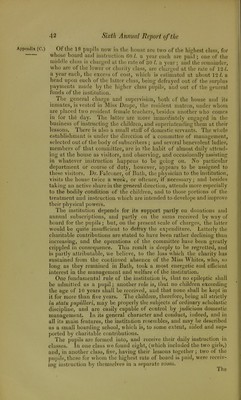
![Appendix (c.) Of the 18 pui)ils now in the house are two of tlie liiuhest class, for whose board and instruction GO /. a year eacli are ])aKi ; one of the middle chiss is charged at the rate of 30 /. a year; and the remainder, who arc of tlie lower or charily chiss, are cliarged at the rale of 12/. a year each, the excess of cost, which is estimated at about 12/. a head upon each of the latter class, being defrayed out of the surplus ])ayments made by the higher class pupils, and out of the general funds of the institution. The o-eneral charge and supervision, both of the house and its inmates, is vested in Miss Drape, the resident matron, under whom are placed two resident female teachers, besides another who comes in for the day. The latter are more immediately engaged in the business of instructing the children, and superintending them at their lessons. There is also a small staff of domestic servants. The whole establishment is undei' the direction of a committee of management, selected out of the body of subscribers ; and several benevolent ladies, members of that committee, are in the habit of almost daily attend- ing at the house as visitors, and observing, and occasionally assisting in whatever instruction happens to be going on. No particular department or course of duty, however, appears to be assigned to these visitors. Dr. Falconer, of Bath, the physician to the institution, visits the house twice a week, or oftener, if necessary; and besides taking an active share in the general direction, attends more especially to the bodily condition of the children, and to those portions of the treatment and instruction which are intended to develope and improve their physical powers. The institution depends for its support partly on donations and annual subscriptions, and partly on the sums received by way of board for the pupils; but, on the present scale of charges, the latter would be quite insufficient to deh'ay the expenditure. Latterly the charitable contributions are stated to have been rather declining than increasing, and the operations of the committee have been greatly crippled in consequence. This result is deeply to be regretted, and is partly attributable, we believe, to the loss which the charity has sustained from the continued absence of the Miss Whites, who, so long as they remained in Bath, took a most energetic and efficient interest in the management and welfare of the institution. One fundamental rule of the institution is, that no epileptic shall be admitted as a pupil; another rule is, that no children exceeding the age of 10 years shall be received, and that none shall be kept in it for mote than five years. The children, therefore, being all strictly in statu jmpillari, may be properly the subjects of ordinary scholastic discipline, and are easily capable of control by judicious domestic management. In its general character and conduct, indeed, and in all its main features, the institution resembles, and may be described as a small boarding school, which is, to some extent, aided and sup- ported by charitable contributions. The pupils are formed into, and receive their daily instruction in classes. In one class we found eight, (which included the two girls,) and, in another class, five, having their lessons together ; two of the pupils, those for whom the highest rate of board is paid, were l eceiv- ing instruction by themselves in a separate room. The](https://iiif.wellcomecollection.org/image/b21292231_0048.jp2/full/800%2C/0/default.jpg)