Medical and surgical aspects of in-knee (genu-valgum) : its relation to rickets, its prevention and its treatment with and without surgical operation / by W.J. Little ; assisted by E. Muirhead Little.
- William John Little
- Date:
- 1882
Licence: Public Domain Mark
Credit: Medical and surgical aspects of in-knee (genu-valgum) : its relation to rickets, its prevention and its treatment with and without surgical operation / by W.J. Little ; assisted by E. Muirhead Little. Source: Wellcome Collection.
Provider: This material has been provided by the Francis A. Countway Library of Medicine, through the Medical Heritage Library. The original may be consulted at the Francis A. Countway Library of Medicine, Harvard Medical School.
69/192 page 45
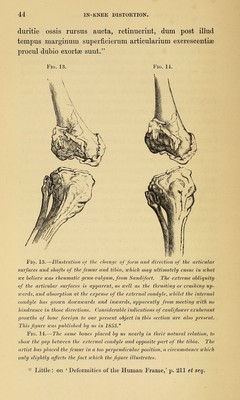
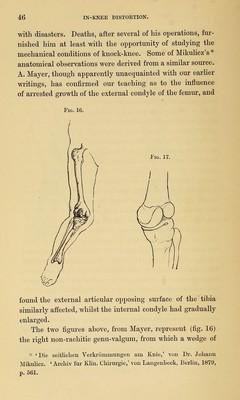
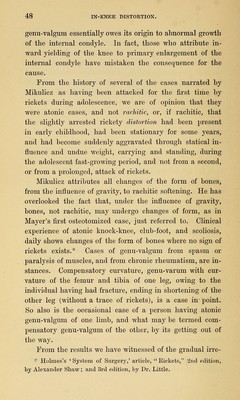
![Fig. 15. We are indebted to A. Mayer* for the next step in posi- tive knowledge of the morbid anatomy. He describes a non-racbitic, but atonic, case of genu-valgum, in which the patient, a boy, walked well up to the age of nine years, when he had severe pertussis of seven months' duration, became wasted, and had so great relaxation (erschlaffung) of the ligaments of the knees that from this period the knees began to incline inwards (op. cit., p. 16). During four years he hobbled about, until marked knock-knee, the re- sult of statical influence, was discovered. At the age of fourteen the lameness was no longer dependent on local weakness. The thigh and leg bones began to parti- cipate in the disorder, inasmuch as the external condylar parts of them, owing to friction and absorption, became flat- tened, whilst the internal condyles of both femora became enlarged and pro- minent. From the age of sixteen the knees began to cross over one another (see fig. 15), and the feet to assume the form of flat-foot. At the age of eighteen Mayer removed a wedge of bone from both tibial. Notwithstanding certain difficulties, he had the satisfaction of seeing his patient's lameness removed. Unhappily the patient died from tetanus two months after operation of the second foot, apparently through sitting on wet grass. Mayer, who was the first to employ osteotomy for the cure of knock-knee, was able from a previous twenty-five years' clinical study of this distortion, in his private Orthopaedic Hospital in Wurzburg, to start on his career of osteotomy with a large stock of knowledge of the different forms of the deformity. As with pioneers in most new surgical operations, his successes were chequered * 0]}. cit. Extreme atonic in-knee, from Mayer.](https://iiif.wellcomecollection.org/image/b21064507_0069.jp2/full/800%2C/0/default.jpg)

 No text description is available for this image
 No text description is available for this image
 No text description is available for this image