The microscope : and its application to vegetable anatomy and physiology / by Dr. Hermann Schacht ; edited by Frederick Currey, M. A.
- Hermann Schacht
- Date:
- 1855
Licence: Public Domain Mark
Credit: The microscope : and its application to vegetable anatomy and physiology / by Dr. Hermann Schacht ; edited by Frederick Currey, M. A. Source: Wellcome Collection.
174/230 (page 150)
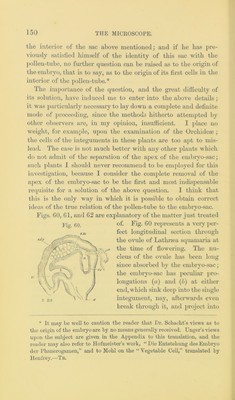
![tlie interior of the sac above inentioued; and if he has jn-e- viously satisfied himself of the identity of this sac with the l)ollen-tnbe, no further question can be raised as to the origin of the embryo, that is to say, as to the origin of its first cells in the interior of the pollen-tube.* The importance of the question, and the great difficidty of its solution, have induced me to enter into tlie above details; it was particularly necessary to lay down a coni2)lete and definite mode of }>roceeding, since the methods hitherto attempted by other observers are, in my opinion, insufficient. I place no weight, for example, upon the examination of the Orchideaj; the cells of the integuments in these plants are too apt to mis- lead. The case is not much better with any other plants which do not admit of the separation of the apex of the embryo-sac; such plants I slioidd never recommend to be employed for this investigation, because I consider the complete removal of the a])ex of the embryo-sac to be the first and most indispensable requisite for a solution of the above question. I think that this is the only way in which it is possible to obtain correct ideas of the true relation of the pollen-tube to the embryo-sac. Figs. 60, Cl, and 62 are explanatory of the matter just treated of. Fig. 60 represents a very per- fect longitudinal section through the ovule of Lathnea squamaria at the time of flowering. The nu- cleus of the ovule has been long since absorbed by the embryo-sac; the embryo-sac has peculiar pro- longations (a) and (5) at either end, which sink dee}) into the single integument, nay, afterwards even break through it, and project into * It may be well to c<aution the reader that Dr. Schacht's views as to tlie origin of the embryo are by no means geuei-ally received. Unger’s views upon the subject are given in the Appendix to this translation, and the reader may also refer to Hofmeister's work, “ Die Entstehung des Embryo der Phanerogamen,” and to Mohl on the “ Vegetable Cell,” translated bj llenfrey.—Tii. Fig. 60.](https://iiif.wellcomecollection.org/image/b28071761_0174.jp2/full/800%2C/0/default.jpg)