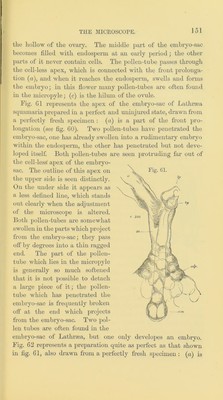
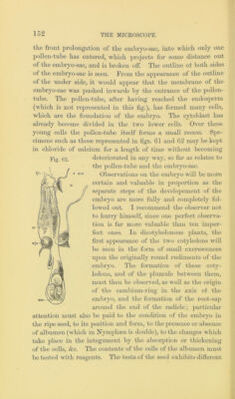
The microscope : and its application to vegetable anatomy and physiology / by Dr. Hermann Schacht ; edited by Frederick Currey, M. A.
- Hermann Schacht
- Date:
- 1855
Licence: Public Domain Mark
Credit: The microscope : and its application to vegetable anatomy and physiology / by Dr. Hermann Schacht ; edited by Frederick Currey, M. A. Source: Wellcome Collection.
180/230 (page 156)
![lo6 the .stem ai'e young and in a state of active growth, they cannot he recommended for observing cell-formation in close tissues, because these cells are very small, and their gmnular contents render observation difficult. The leaf of Sphagnum and the leaves of liverworts are better fitted for this investigation, which, however, can be best carried on upon the cell-formation in the embryo-sac. The fir.st cells in the embiyo-sac originate around free nuclei; these first cells afterwards become mother- cells, which form secondary cells (Tochter-zellen) by di\dsion of their cell-contents. In the embryo-sac, therefore, fine cell- formation and cell-formation by division may both be observed. Cynoglossum, Pedicularis sylvatica, Khiiianthus major, (fee., are favourable plants for this purpose. I believe that there is only one kind of cell-formation, that i.s, a formation of young cells in the interior of mother-cells. I believe that no cell-formation ever takes place without the pin- sence of a cytoblast; the cytoblast originates in the division of an older cytoblast, which latter generally falls into two pieces. In Anthoceros the new cytoblast becomes di\'ided in the same manner. The influence of the cytoblast upon the origin of the young cell is veiy clearly seen in Anthoceros. A mass of muci- laginous threads pass off from the j)eriphery of the mother- cell to the cytoblasts; the mucilaginous investment of the mother-cell is finally divided into four parts, into four closed mucilaginoiis cells, each of which has its c}doblast; the layer of cellulose which is devoid of nitrogen is afterwards develo]>ed over the primary nitrogenous membrane. In the embryo-sac of phanerogamous plants also, the cytoblast appears first; this is surroimded by a more or less extensive zone of mucilage, out of which the primary nitrogenous covering, i. e., the jiriniordial utricle, appears to be foianed, and over the primordial utricle the covering of cellulose, i. e., the proper cell-membrane is formed at a subsequent period. In the embryo-sac the cell-formation always commences in the periphery of its membrane; it woidd appear, therefore, that the nitrogenous covering of the latter, that is, the primordial utricle, is active in cell-formation. I must, therefore, in com- mon with most vegetable physiologists, admit two motlifications](https://iiif.wellcomecollection.org/image/b28071761_0180.jp2/full/800%2C/0/default.jpg)