The microscope : and its application to vegetable anatomy and physiology / by Dr. Hermann Schacht ; edited by Frederick Currey, M. A.
- Hermann Schacht
- Date:
- 1855
Licence: Public Domain Mark
Credit: The microscope : and its application to vegetable anatomy and physiology / by Dr. Hermann Schacht ; edited by Frederick Currey, M. A. Source: Wellcome Collection.
198/230 (page 174)
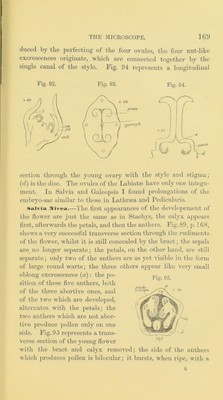
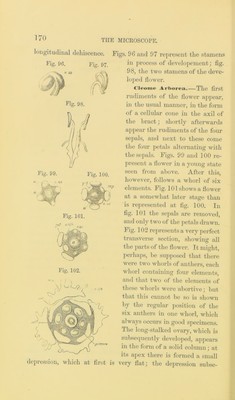
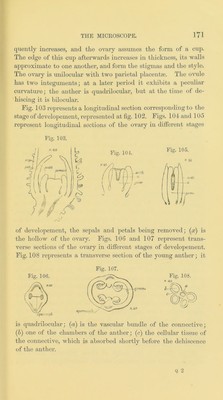
![tationis, protected by a few scale-like leaves; until the middle of the Summer it continues to form scales only, ft is not until the young branch upon which the bud is jdaced has attained its full growth, and has begun to form its autumnal wood, that the punctiim vegetationis elevates itself, and from that time no more scales are formed, but rudiments of leaves begin to gi’ow, which by degrees become developed into anthers. The catkin-bud of Abies pectinata only differs at first from the cone-bud of the same tree, in being situated on the under- side of the young branch, and in the fact of the contemporaneous appearance of many buds in the neighbourhood of one another. The cone-l)ud always appears on tlie upper side of other (female) branches, and is, moreover, solitary. The process of develope- ment which takes jdace in the interior of both species of buds is at first alike; in the latter part of the Summer, however, as soon as true leaves are formed in lieu of scales, essential dif- ferences arise: the leaf of the male catkin exhibits no axillary buds, which latter are found in the cone-bud shortly after the appearance of the leaf, and these in the succeeding Spring form fruit-scales, upon which the ovules are developed. On the other hand, the leaf of the male catkin bec^omes the anther, whilst a longitudinal row of large cells is developed on both sides of a cambium-striuxj, which originates from the thickening-ring of the axis or stem of the bud. These cells are nourished by the con- tiguous smaller cellular tissue, and in their interior the mother- cells of the pollen-grains, or the cells which give origin to the mother-cells, are formed. The vascular bundle, or connective of the anthei’, is formed in the following 3'ear out of the cambium-string. Even in August the jmung anther of Abies pectinata, Picea vulgaris, Pinus sylvestris, and Larix is bilocular. B}’ the end of Seji- tember, four young pollen-grains are found in each mother- cell of these anthers. From this time until the beginning of Spring, no changes of im])oi’tance take place; the cone-bud also makes no further progress during the Winter. At the beginning of IMa\'', the pollen-grains of Abies pectinata and Picea vulo'aris lie in fours in the interior of their mother- cell.](https://iiif.wellcomecollection.org/image/b28071761_0198.jp2/full/800%2C/0/default.jpg)