The microscope : and its application to vegetable anatomy and physiology / by Dr. Hermann Schacht ; edited by Frederick Currey, M. A.
- Hermann Schacht
- Date:
- 1855
Licence: Public Domain Mark
Credit: The microscope : and its application to vegetable anatomy and physiology / by Dr. Hermann Schacht ; edited by Frederick Currey, M. A. Source: Wellcome Collection.
203/230 (page 179)
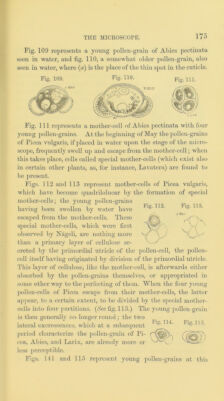
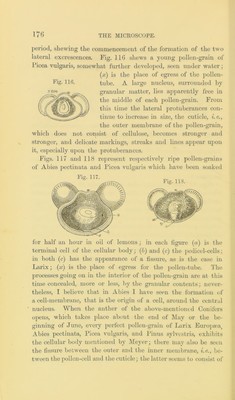
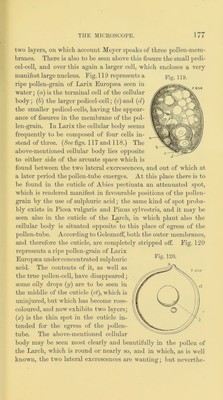
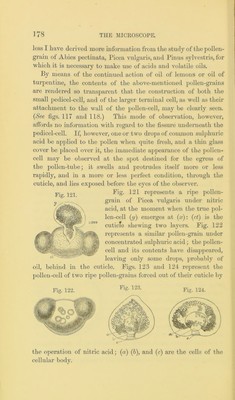
![The empty cuticle now exhibits its markings still more beau- tifully. It is now seen that as well in Abies i)ectinata as in Picea vulgaris and Pinus sylvestris, the cuticle is very strongly developed at the two excrescences, and still more so between them, opposite to the place of egress of the pollen-tube, at the point of attachment of the cellular body. At the places where the cuticle is thus strongly developed two layers may frequently be clearly seen. The fissure between the pollen-cell aud the cuticle has now disa]>peared; but three cells (and not two only, as in the earlier stages) are always to be seen in the emergent pollen-cell, and these three cells form the cellular body in its interior. (See a, b, and c, figs. 118, 123, and 124.) The lowest of these cells (c) is generally the smallest, and becomes united in its growth to the wall of the pollen-cell, which fact is clearly seen by pushing the covering-glass backwards and for- wards; it was this cell which at an earlier period formed the apparent fissure between the cuticle and the j)ollen-cell. The contiguous cell (h), which is somewhat larger, and which has been hitherto called the pedicel-cell, supports a third cell, viz., the the teiminal cell of the cellular body (a). I have never seen more than three cells in Abies pectinata, Picea vulgaris, and Pinus sylvestris; but I have never failed to see any one of these three cells in the perfect pollen-grain. Although I have not been able to trace the developement of the cellular body, it may perhaps be assumed that its three cells originate from the one cell which I have observed in the pollen-grain of Abies pectinata, and proljably by repeated di\fi- sions of the primordial utricle. The two pedicel-cells, when once formed, do not seem to increase in size, but the terminal-cell gi'ows visibly; in Pinus sylvestris I have met with instances in which the latter cell has completely displaced the granular contents of the pollen-cell, and become distended to such a size as to fill up completely the hollow of the latter. The true pollen-cell a})peared about this time to be much decayed, and of a gelatinous consistency; at the apex it was com- pletely absorbed. I cannot, therefore, at present subscribe to Geleznofl’s opinion, that the pollen-tube is formed of two memijraues.](https://iiif.wellcomecollection.org/image/b28071761_0203.jp2/full/800%2C/0/default.jpg)