The microscope : and its application to vegetable anatomy and physiology / by Dr. Hermann Schacht ; edited by Frederick Currey, M. A.
- Hermann Schacht
- Date:
- 1855
Licence: Public Domain Mark
Credit: The microscope : and its application to vegetable anatomy and physiology / by Dr. Hermann Schacht ; edited by Frederick Currey, M. A. Source: Wellcome Collection.
218/230 (page 194)
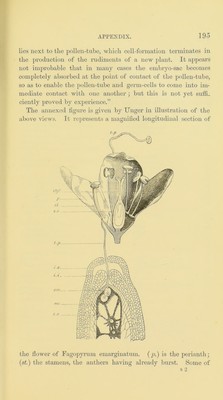
![in contact with it, and especially with its apex. This a})ex, called the style, which originates in the growing together of the apices of the cai'pels, and which, according to the form of the lattei’, is shoider or more elongated, spreads ont somewhat more widely at the point called the stigma. Those pollen- grains which fall npon the stigma are acted uj)on hy a moist secretion, continually exuding from the stigma, which super- induces a further (leveloi)inent, a fuither growth, or, as one may say, a germination, the result of which is, that a cellular iitricle is (levelo])cd behind the external covering of the ])ollen-grain, which utricle, although single, is in a condition to branch out, by protruding itself through the external covering. The ger- minating pollen-grain, lioweA'er, notwithstanding the moisture of the stigma, would soon perish, if it weie not in a condition, by means of its projecting end, to make a passage for itself between the loose cells of the stigma, and between the slightly- connected tissue of the style. After .some time one or more of the })ollen-grains always succeeds in effecting a pas.sage doAvn- Avards into the ovary. There are noAv but feAV more difficulties to be OA^ei’come. The apex of the groAving ]X)llen-tube easily reaches the ovule, and finds there, through the openings in the coats of the oAuile, an uninterrupted passage to the nucleus. Finally, however, the cells of the nucleus must be broken through. This is easily done, ina.smuch as these cells are still very tender and yielding, and, at the same time, the embryo- sac, through its OAvn extension and the disphxcement of tlm cells above, is, to a certain extent, brought in ap}X)sition to the pollen-tube. The germ-cells in the interior of the embrAo-sac itself are found at this period near the surface ; they even touch the inner side of its Avail. It is, therefore, an eas}^ matter for the pollen-tube, haAung ])enetratcd thus far, to oome into immediate contact A\dth the germ-cells, from Avhich it is only separated by the membrane of the embryo-sac ■, the pollen-tube (iveu s])reads itself OA'er the surface of the embryo-.sac, in order, if possible, forcibly to bring about this contact. The result is, that Avhilst the pollen-tube Avithers by degrees, the process of decay being from the exterior imvards, a further cell-formation commences in one of the germ-cells, probably in that one AA'hich](https://iiif.wellcomecollection.org/image/b28071761_0218.jp2/full/800%2C/0/default.jpg)