The microscope : and its application to vegetable anatomy and physiology / by Dr. Hermann Schacht ; edited by Frederick Currey, M. A.
- Hermann Schacht
- Date:
- 1855
Licence: Public Domain Mark
Credit: The microscope : and its application to vegetable anatomy and physiology / by Dr. Hermann Schacht ; edited by Frederick Currey, M. A. Source: Wellcome Collection.
26/230 page 2
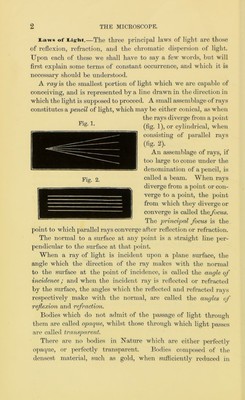
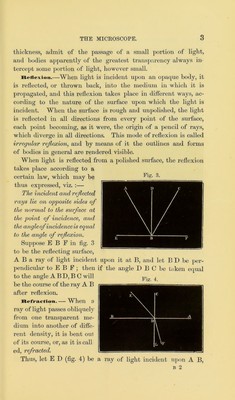
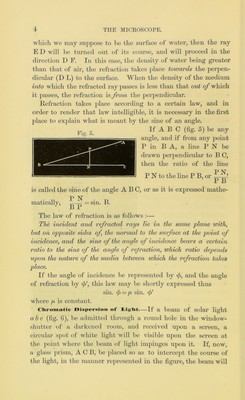
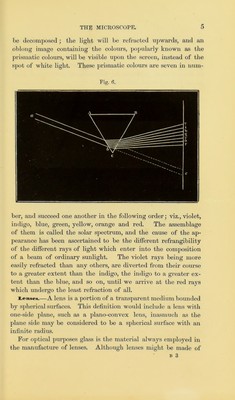
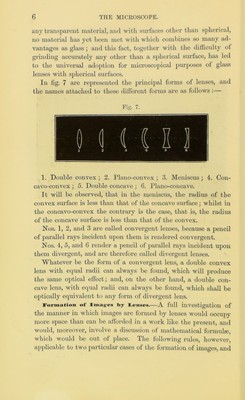
![i.awii of —The three princij)al law.s of light are those of reflexion, refraction, and the chiornatic dispersion of liglit. Upon each of these we shall have to say a few words, hut will firat explain some terms of constant occurrence, and which it is necessaiy slioukl be understood. A ray is the smallest portion of light which we are caj)able of conceiving, and is represented by a line drawn in the direction in which the light is supposed to proceed. A small assemblage of rays con.stitutes a 'pencil of light, which may be either conical, as when the rays diverge from a point (fig. 1), or cylindrical, when consisting of j)arallel rays (%. ^). An assemblage of rays, if too large to come under the denomination of a pencil, is called a beam. When rays diverge from a point or con- verge to a point, the jX)int from which they diverge or converge is called thefocus. The ]rrincip(d focus is the point to which parallel rays converge after reflection or refi-action. The normal to a surface at any point is a straight line per- pendicular to the siu'face at that ]X)int. When a ray of light is incident upon a plane surface, the angle which the direction of the ray makes with the normal to the siirface at the point of incidence, is called the angle of incidence; and when the incident ray is reflected or refracted by the surface, the angles which the i-eflected and rafracted rays respectively make with the normal, are eddied the angles of reflexion and refraction. Bodies which do not admit of the jiassage of light through them are called opaque, whilst those tlirough which light passes are called transpa.reiit. There are no bodies in Nature wliich are either ]>erfectly opacpie, or perfectly ti*ansparent. Bodies composed of the densest material, such as gold, when sufficiently reduced in](https://iiif.wellcomecollection.org/image/b28071761_0026.jp2/full/800%2C/0/default.jpg)
 No text description is available for this image
 No text description is available for this image
 No text description is available for this image