The microscope : and its application to vegetable anatomy and physiology / by Dr. Hermann Schacht ; edited by Frederick Currey, M. A.
- Hermann Schacht
- Date:
- 1855
Licence: Public Domain Mark
Credit: The microscope : and its application to vegetable anatomy and physiology / by Dr. Hermann Schacht ; edited by Frederick Currey, M. A. Source: Wellcome Collection.
28/230 (page 4)
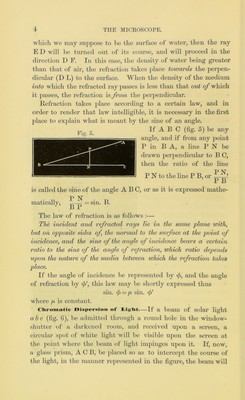
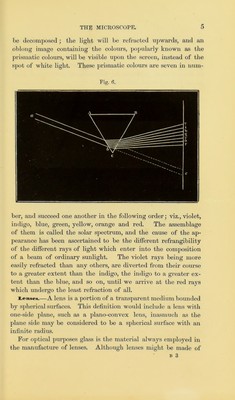
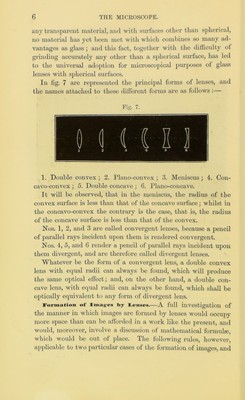
![wliicli we may sixpj^ose to be the surface of water, tlien the ray E D will b(i turned out of its coui’se, and wall proceed in the direction D F. In this Cixse, the density of w^ater being gi’eater than that of air, the reflection takes place towards the perpen- dicidar (D L) to the surface. When the density of the medium into which the refi-acted ray passes is less than that out of which it passes, the reflection is from the perpendicular. Refraction takes place according to a ceilaiii law, and in 01‘der to render that law intelligible, it is necessary in the first place to explain what is meant by the .sine of an angle. If A B C (fig. 5) be any angle, and if from any jxiint P in B A, a line P N be drawn perpendicular to B C, then the ratio of the line P N to the line P B, or ^ ’ P B is called the sine of the angle ABC, or as it is expressed mathe- P N inatically, = sin. B. The law of refraction is as follows :— The incident and refracted rays lie in the same iTilaiw with, but on opposite sides of, the nornud to the stirface at the point of incidence, and the si,ne of the angle of incidence hears a certain ratio to the sine of the angle of refraction, which ratio depemls upon the nature of the media between lohich the refraction takes place. If the angle of incidence be represented by </>, and the angle of refraction by </>', this law may be shortly expressed thus sin. ^ — p sin. c/)' Avhere p is constant. CUroinatic of —If a beam of solar light abc (fig. 6), be admitted through a round hole in the window- shutter of a darkened room, and received upon a screen, a circular spot of white light will be visible upon the screen at the point where the beam of light impinges upon it. If, now, a ghuss prism, A 0 B, be ])laced so as to intercept the course of the light, in the manner represented in the figime, the beam wall](https://iiif.wellcomecollection.org/image/b28071761_0028.jp2/full/800%2C/0/default.jpg)