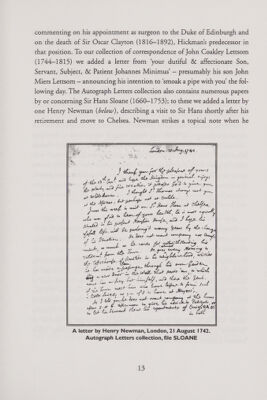
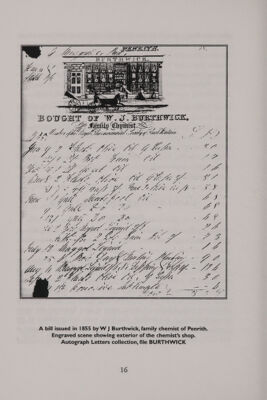
Annual review : 1994/95 / Wellcome Institute for the History of Medicine, Department of Western Manuscripts.
- Wellcome Institute for the History of Medicine. Department of Western Manuscripts
- Date:
- 1995
Licence: Attribution 4.0 International (CC BY 4.0)
Credit: Annual review : 1994/95 / Wellcome Institute for the History of Medicine, Department of Western Manuscripts. Source: Wellcome Collection.
24/40 (page 18)
![(MSS 8968-8989), this material complementing the many other papers on this project among our holdings. The index to the letters of Henry Lee (1826-1888), mentioned as ‘in progress’ last year, has been completed as Western Manuscripts handlist no. 28. Lee, naturalist to the Brighton aquarium, is described in the Dictionary of National Biography as ‘popular in society,’ and his correspondence attests to his wide social circle. He seems to have had many friends in the theatre, whose letters are sometimes less stilted than most Victorian prose. One, writ- ing in 1873, complained about self-censorship of the press concerning the exiled French emperor: ‘I am disgusted with their [i.e. the London papers’] purchased toadyism in making such a fuss about the “alarming illness of his Imperial Majesty the Emperor Napoleon,” he rated, ‘when the fact is that a man named Louis Napoleon is suffering from the effects of early cock-flashing, and there are thousands in the Lock Hospitals in the same condition; Halleluyah! and the Daily Telegraph.’ Barlow papers The papers of the various members of Sir Thomas Barlow’s family have been catalogued and their correspondence indexed, where appropriate. The com- pleted catalogue of the entire family archive (PP/BAR) will shortly be avail- able in the Poynter Room, following final editing. Barlow had a number of distinguished relatives, not least his own children. His second son, Thomas Dalmahoy Barlow (1883-1964), entered the family textile business, became a prominent industrialist, Director-General of Civilian Clothing during the Second World War and, later, Chairman of the District Bank. On his first visit to America in 1906, as a young member of a British trade delegation, he breathlessly described to his mother his impressions of the city of Boston in terms that reveal the bewildering impact of large American cities on visi- tors from the more orderly environment of Britain. At one stage the party’s progress down the road was interrupted by ‘a great train of Heinz’s sauce](https://iiif.wellcomecollection.org/image/b31853833_0024.jp2/full/800%2C/0/default.jpg)