A manual of chemistry, inorganic and organic : inorganic and organic, with an introduction to the study of chemistry / by Arthur P. Luff.
- Arthur P. Luff
- Date:
- 1892
Licence: Public Domain Mark
Credit: A manual of chemistry, inorganic and organic : inorganic and organic, with an introduction to the study of chemistry / by Arthur P. Luff. Source: Wellcome Collection.
Provider: This material has been provided by Royal College of Physicians, London. The original may be consulted at Royal College of Physicians, London.
61/558 (page 41)
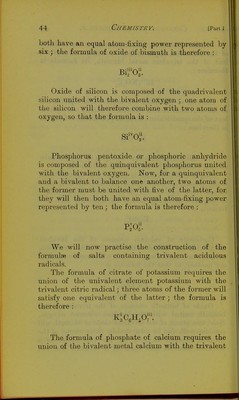
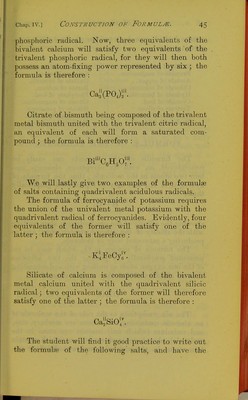
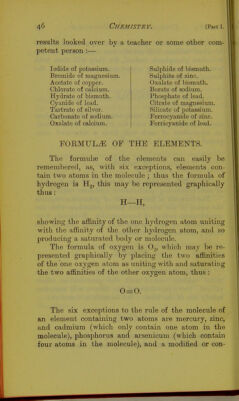
![CHAPTER IV. Formulse—Construction of Formulre—Formulse of the Elements— Appsirently Abnormal Foraaiilfe—Molecular Weights—Speci- fic Gravities of Gases and Vapours—Empirical, Molecular, and Constitutional Formulte—Uses of Terminations. FORMULA. A formula is a representation of the composition of a body by means of symbols, which may be re- garded as chemical shorthand; it consists of a grouping of the symbols of tlie elements composing the body, with numbers attached to these symbols indicating the proportions in which the elements occur in the body; when no number is attached to the symbol of an ele- ment, the number one is understood. We will now show, by a few examples, how to construct the formulae of acids and salts. An acid is simply a compound of an acidulous radical with hydrogen. Hydi-ogen being a univalent element, a univalent acidulous radical will unite with, and be saturated by, one atom of hydrogen ; thus : H'CI' is the formula of hydrochloric acid. H'NO], „ „ nitric acid. H'CaHsOji ,, „ acetic acid. A bivalent acidulous radical will require two atoms of the univalent hydrogen to saturate it; thus : H2SO4 is the formula of sulphuric acid. HijCnO ,, oxalic acid. Hj C4H4O6 „ tartaric acid.](https://iiif.wellcomecollection.org/image/b22651597_0061.jp2/full/800%2C/0/default.jpg)