The anatomy of melancholy : what it is, with all the kinds, causes, symptoms, prognostics, and several cures of it. In three partitions. With their several sections, members, and subsections, philosophically, medicinally, historically opened and cut up / by Democritus Junior. With a satirical preface, conducing to the following discourse.
- Robert Burton
- Date:
- 1849
Licence: Public Domain Mark
Credit: The anatomy of melancholy : what it is, with all the kinds, causes, symptoms, prognostics, and several cures of it. In three partitions. With their several sections, members, and subsections, philosophically, medicinally, historically opened and cut up / by Democritus Junior. With a satirical preface, conducing to the following discourse. Source: Wellcome Collection.
107/778 page 81
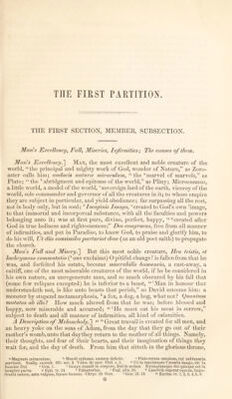
![TIIE FIRST PARTITION. THE FIRST SECTION, MEMBER, SUBSECTION. Man's Excellency, Fall, Miseries, Infirmities; The causes of them. 31 an's Excellency.] Man, the most excellent and noble creature of the world, “ the principal and mighty work of God, wonder of Nature,” as Zoro- aster calls him; audacis naturce miraculum, “ the amarvel of marvels,” as Plato; “the b abridgment and epitome of the world,” as Pliny; Microcosmus, a little world, a model of the world,csovereign lord of the earth, viceroy of the world, sole commander and governor of all the creatures in it; to whose empire they are subject in particular, and yield obedience; far surpassing all the rest, not in body only, but in soul; dImaginis Imago,ecreated to God’s own fimage, to that immortal and incorporeal substance, with all the faculties and powers belonging unto it; was at first pure, divine, perfect, happy, created after God in true holiness and righteousness;” Deo congruens, free from all manner of infirmities, and put in Paradise, to know God, to praise and glorify him, to do his will, Ut diis consimilesparturiat deos (as an old poet saith) to propagate the church. Alan's Fall and Misery. ] But this most noble creature, lieu tristis, et lachrymosa commutatio (hone exclaims) O pitiful change! is fallen from that he was, and forfeited his estate, become miserabilis homuncio, a cast-away, a caitiff, one of the most miserable creatures of the world, if he be considered in his own nature, an unregenerate man, and so much obscured by his fall that (some few reliques excepted) he is inferior to a beast, “Man in honour that understandeth not, is like unto beasts that perish,” so David esteems him: a monster by stupend metamorphosis, ka fox, a dog, a hog, what not? Quantum mutatus ab illo? How much altered from that he was; before blessed and happy, now miserable and accursed; “Die must eat his meat in sorrow,” subject to death and all manner of infirmities, all kind of calamities. A Description of Alelancholy.] “ m Great travail is created for all men, and an heavy yoke on the sons of Adam, from the day that they go out of their mother’s womb, unto that day they return to the mother of all things. Namely, their thoughts, and fear of their hearts, and their imagination of things they wait for, and the day of death. From him that sitteth in the glorious throne, a Magnum miraculum. b Mundi epitome, naturae deliciae. c Finis rerum omnium, cui sublunaria serviunt. Scalig. exercit. 365. sec. 3. Vales, de sacr. Phil. c. 5. d Ut in numismate Caesaris imago, sic in homine Dei. e Gen. 1. f Imago mundi in corpore, Dei in anima. Exemplumque dei quisque est in imagine parva. s Eph. iv. 24. h Palanterius. 5 Psal. xlix. 20. k Lascivi& superat equum, impu- dentia canem, astu vulpem, furore leonem. Chrys. 23. Gen. 1 Gen. iii. 13. ra Ecclus. iv. 1, 2, 3, 4,5, 8. Gr](https://iiif.wellcomecollection.org/image/b29300022_0107.jp2/full/800%2C/0/default.jpg)
 No text description is available for this image
 No text description is available for this image
 No text description is available for this image