Licence: Public Domain Mark
Credit: The bronchial catarrh of children / by James Carmichael. Source: Wellcome Collection.
Provider: This material has been provided by the Royal College of Physicians of Edinburgh. The original may be consulted at the Royal College of Physicians of Edinburgh.
16/28
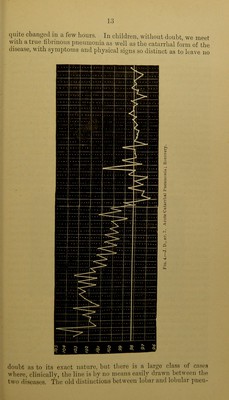
![iiioiiia are of comparatively little value in the cliild, as we meet witli cases of lobar catarrhal piieimioiiia which at first sight, at all events, are not so readily distinguished from the croupous variety of the disease. All observers are agreed that the acute catarrhal pneu- monia of childhood is essentially a disease of early life. What, then, are its distinguishing characters ? The first fact to lay hold of is, that it is a secondary disease, closely associated witii, generally com))licat- ing, bronchial catarrh. It occui-s during the progress of this disease especially when the ultimate bronchial ramifications are involved. Clinically it is difficult, often well-nigh impossible, to distinguish between capillary bronchitis and acute catarrhal pneumonia. Pro- bably capillary bronchitis rarely occurs in a young child uncompli- cated by catarrhal pneumonia. The recognition of the occurrence of this complication, as a rule, presents few difficulties. The previous existence of bronchial catarrh itself, if extensive, affords strong pre- sumption of its occurrence. The diagnosis may be assured by a consideration of the general clinical features of the case, more particularly as regards symptoms, physical signs at the commence- ment, and when the disease is limited in extent, and possibly con- fined to a central p^ortion of lung, being often indistinct in their character. When larger portions of lung are involved the physical signs are well marked, and give clear indication of the true nature of the complication. I have already sketched tlie symp)toms of bronchial cataiTh, whether of a slight or severe character, and in order to a recog- nition of the occurrence of catarrhal pneumonia it is*necessary to keep) them in remembrance, and to note the changes in the clinical features of the case which the supervention of catarrhal infiamiha- tion of the alveoli gives rise to. Let us, by way of illustration, again ]iicture the case of child suffering from extensive bronchial catarrh. The Iiurried breathing, the constant harsh cough, often paroxysmal in its nature, the accelerated pulse, the anxious and distressed look, the disinclination for food or playthings, the foul tongue, the unhealthy stools, the more or less frequent vomiting of undigested food and mucus. All the while the temperature is not very high, ranging from 99° to 101°, with no great variation, its ratio to that of the pulse being pretty constant. Let us note the changes which take j)lace in the supervention of catarrhal pneu- monia. Its onset is signalized by a marked change in the symptoms from those of the ordinary bronchial catarrh which has preceded it. Probably one of the first noticeable alterations in the symptoms is the cough, which invariably changes its features. It loses its purely bronchial character, and becomes shallow, short, and liacking, and apparently accompanied by pain during the act. The cough may be more frequent—often very constant—and irritating, but sometimes one of the most characteristic features is its diminished frequency. At the same time the respirations arc much accelerated and shallower than betore, running up to](https://iiif.wellcomecollection.org/image/b21695222_0016.jp2/full/800%2C/0/default.jpg)