Ninth annual report of the Local Government Board 1879-80. Supplement containing report and papers submitted by the Medical Officer on the recent progress of the Levantine plague, and on quarantine in the Red Sea.
- Date:
- 1881
Licence: Public Domain Mark
Credit: Ninth annual report of the Local Government Board 1879-80. Supplement containing report and papers submitted by the Medical Officer on the recent progress of the Levantine plague, and on quarantine in the Red Sea. Source: Wellcome Collection.
21/322 (page 5)
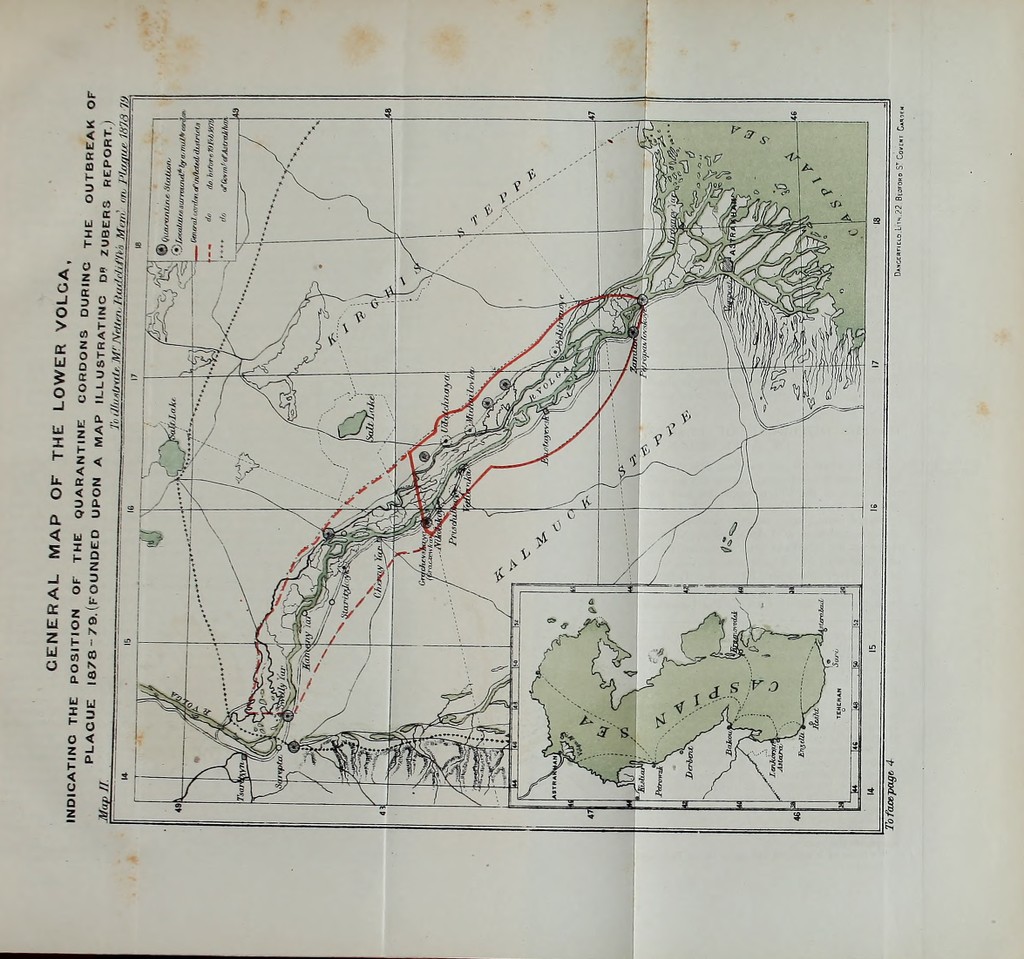
![on either bank of the river within the infected district having suffered Apf^o. i. comparatively little, so far as is known, from plague.* On ti>^e Pro^^^^^^^ The Lower Volga in that part of its course where plague hrst appearea, Plague in 1878- consists, when in ordinary flow, of two principal streams. (.S'eeMap III.) ^^yM^^-Gotten The main stream runs beneath the right bank, and a considerable navi- _^ sable branch, known as the river Achtuba, passes beneath the left bank P^lagub ok^thb The bed of the river here is several miles wide (somewhat over 10 miles at Vetlianka) and, except when the river is in flood, the stream Topography. &c. then occupying the whole of its bed, a network of channels, passing amidst sandbanks and low marshy islands covered with a rank growth oi grass and patches of reeds, connects the main channel and the Achtuba with each other.f The right bank of the river is steep, and has a height * Le gouverneur [d'Astrakhan], qui se trouve actuellement h Yenotaiev, fait savoir e£ralement que les habitants de la stanitza Vetlianskaia, refugies au com- '•- menoement de I'epidemie dans les localites voisines, ont importe le mal dans trois autres villages et dans un oulous Kalmouk, ou quelques cas de mortalite se sont « deja produits. Messager Officiel quoted by Journal de St. Petersbourcj, De- cember 27tli, 1878 (7tli and 8th January 1879). Depuis le ler (ISth) Janvier on « n'a constate aucim cas de maladie epidemique parml la population nomade Kalmouke et Khirghize. Telegram from the Governor of Astrakhan, dated 5th (17th) January 1879. Journal de St. Petersbourg, 7th and 8th (19th and 20th) January 1879. A la date du 2 (14th) Janvier, le ciief de la police du district d'Enotaievsk telegraphic au gouverneur que plusieurs Cosaques enfiiis de Wetlianka avant I'isolement de cette stanitza et refugies dans leurs terres sur la rive gauche, ont succombe a I'epidemie, de sorte que I'on trouve encore aujourd'hui leurs cadavres etendu de cote et d'autre. (Zuber, p. 118. Extrait du Journal Officiel du Gouverne- meiit d'Astrakhan, 6th (18th) Janvier 1879. t We crossed the bed of the Volga from Kosakinski to Selitrenoi, nearly opposite. In a large canoe we threaded our way amongst sand banks bearing trees and brush- wood, with here an occasional village or half-a-dozen cottages, or a fish-curing shed, to the main stream of the Volga, which we crossed at Ntchuchneya. This little village is on the edge of the main stream, and between it and the left bank, 8 miles distant in a direct line, is low marsh land. Though within less than a month of the annual rise of the Volga, and though neither snow nor rain has lately fallen, this low land, which follows the course of the river up and down, is not only greeu and damp, but resembles marsh land, intersected with swamps and patches of reeds, and sprinkled with ftesh-water shells from the early inundation. Looking at the herds of swine, which here, however, are tame, rooting, it was difficult to believe we were not on corresponding ground in Mesopotamia. Wild duck abound. In the history of Sarepta it is mentioned that small German colonies formerly settled on this low ground, but were decimated by the imhealthiness of the situation. This land is too damp to produce grain on any part of it, but rank grass gi'ows abundantly, and it is dotted over, at intervals of about a mile, with what may be called grazing farms, inclosures of hurdles, and sheds for cattle, where the constant accumulation of dung unremoved, unless required for fuel, raises the level of the station year by year. The huts for Russian inhabitants ai-e of wood, or hurdle plastered over, and wretched indeed, while the winter home of the Kalmuk attendants is at least four feet under- ground. The whole is surrounded by an embankment resting against the buildings to keep out the river at its height. From the middle of May the Volga rises, and in June is at its height, and during the latter half of July and August it has again retired and left this tract of land still more a swamp. This portion of land might bo considered an island in the low season, for a channel of the Volga, called the Achtuba, leaves the main stream higher up, and running under the left -bank falls as a separate river into the Caspian Sea. Six miles higher up than where we crossed, but through which we recrossed, an apparently undefined portion of this marsh ground is called Kapitanski, and on it we found the remains of LapiroflPs farm,* to be afterwards referred to. ****** In May and June the river will be above the site of these farms, and communication with them will be possible only by boats. In July and August, the river retii-iiig, the country will be even more of a swamp, with a temperature sufficient to ripen water melons. This is not a mere patch of land ; it is true that it is but 8 miles broad, but wc have seen and heard of it during our journey here ; it will follow us to the Caspian Sea, and it probably extends much higher up than where we met the river. We have, both of us, felt its evil influence by being attacked with ague. If it is said that in winter the Volga is frozen and the land ice bound, the high temperature at which even the poor keep their rooms must * See p. 19. Q 5263. B](https://iiif.wellcomecollection.org/image/b20419703_0021.jp2/full/800%2C/0/default.jpg)