Ninth annual report of the Local Government Board 1879-80. Supplement containing report and papers submitted by the Medical Officer on the recent progress of the Levantine plague, and on quarantine in the Red Sea.
- Date:
- 1881
Licence: Public Domain Mark
Credit: Ninth annual report of the Local Government Board 1879-80. Supplement containing report and papers submitted by the Medical Officer on the recent progress of the Levantine plague, and on quarantine in the Red Sea. Source: Wellcome Collection.
39/322 (page 19)
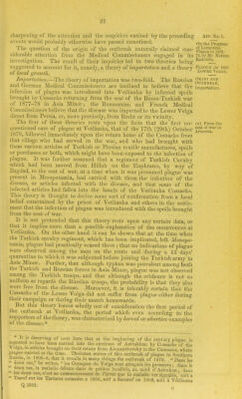
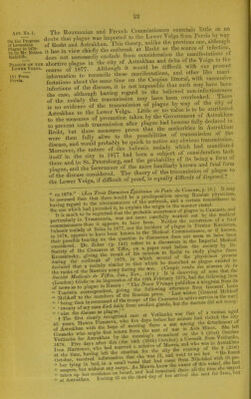
![the last on the 28th January (9th February). Altogether 34 cases Apr^o.i. were recorded, of whom 28 died and two recovered, and of foiu- the on the Progress results are not stated.* The close linking together of the cases is shown pia^'^Je'!;!gTs- by the following summaiy statement:— itid^rtfe The fii'st person who was attacked by the disease was a peasant named Plaxin, and following in rapid succession his wife, a married son, mGUE on^tde and the son's wife, were taken ill. The Avoman who recited prayers over the sou's corpse also fell a victim to the disease, and his two childi-en. A sister and the step-daughter of Plaxin were attacked and died, as likewise the two women who prepared their bodies for bm-ial, and of these women the husband, the sister, and a workman of one caught the disease and died, and the daughter of the other. A shoemaker more- over, who lodged in Plaxin's house and one of his two children also succumbed to the disease. Two days before Plaxiu's son died he spent the nigbt at a farm on an island in the Volga, occupied by a family named Laparev. Four or five days afterwards the farmer and his wife were seized with plague, and brought to the lazaret which had been established in Selitrenoye. The woman who conveyed them there was attacked by the disease, also the fanner's daughter, mother, and a sister. Three men, who had spent the night at Laparev's farm the nigbt before the farmer and his wife were carried to the lazai'et, were all attacked with plague, and of one of these men, named Efim Laparev, his wife and four children, subsequently suflFered fi-om the disease. In addition a Kirghis family, consisting of a man, his wife, and a child, occupying a kibitka near to Laparev's farm, and in close com- munication with it, were all carried off by the disease. | Plaxin. The peasant (died 28th December (9th January). His wife (died 3rd (15th) January). His son (died 8th (20th) January). The son's wife (taken ill 10th (22nd) January). The son's two children (one died 18th (30th) January). The woman who read prayers over the son's body (died 19th (31st) January). His sister died 12th I The two women (1 andT fThe husband. (24th) January). [■ 2) who prepared Ithe [ A sister (died 19th His stepdaughter (ditto) J bodies for burial died f (31st January). 13th (25th) January).J l-j A workman employed by husband (recovered 25th January — 6th February). A daughter (19th (31st) January). Another member of the j family(diedl8th(30th) January). * I have followed here Dr. Petresco's detailed account, but he gives the niunber of the sick as 33, of whom 31 died and two recovered. Dr. Zuber states that the number of the sick was 32, of the deaths 30. t Messrs. Colvill and Payne describe the site of Laparev's (Lapirofif s) farm as follows:— This farm, probably bearing the description we have given [sec iVo<e p. 5] had been fired from the ujtper end when the wind was in the north, for a portion of a shed and one or two hurdles remained; and not only were two piles of dung dried for fuel burning, but the surface of the ground was on fire, showing the great thickness of the manure deposit, and this fire will probably smoulder for a month if neither the rising river nor rain extinguishes it. It is true the walls of these farmhouses are thicker than the reed huts on the Euphrates, but they rest on the gi-ound with no spaces underneath, as in the houses on the mainland. They are entirely of vegetable matter: not a cartload of bricks, and those probably the remains of stoves, could be found on the site of Lapiroff's farm. The surrounding coimtry is undoubtedly a marsh.](https://iiif.wellcomecollection.org/image/b20419703_0039.jp2/full/800%2C/0/default.jpg)