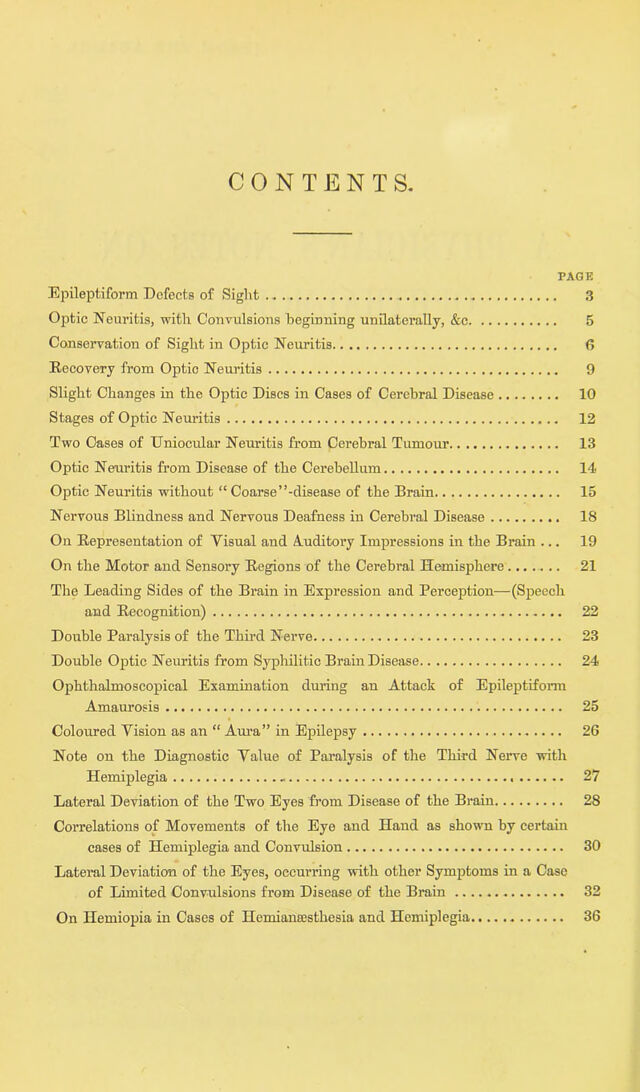
A physician's notes on ophthalmology / by J. Hughlings Jackson.
- Jackson, John Hughlings, 1834-1911.
- Date:
- [1874]
Licence: Public Domain Mark
Credit: A physician's notes on ophthalmology / by J. Hughlings Jackson. Source: Wellcome Collection.
Provider: This material has been provided by The Royal College of Surgeons of England. The original may be consulted at The Royal College of Surgeons of England.
20/38 page 20
![therein. I mention this as I think it possible that some may suppose I necessarily draw that conclusion. Mr. Hinton, in his just published work on “Aural Surgery,” p. 20, after re- marking that the cerebral centres, “ not only of emotion but of motion,” are “ eminently liable to be affected through im- pressions on the ear,” writes, “ It seems, therefore, the more remarkable that—in contrast to the eye—Dr. Hughlings Jackson should have found no lesion of the brain or cere- bellum that has deafness as its result, except through mechanically involving the auditory nerve.”* • As the following extract will show, I have long drawn the very opposite conclusion. The extract is of sentences follow- ing those already quoted in the last Section (10) from the. Royal London Ophthalmic Hospital Reports. “ This,” (the absence of deafness in disease of the brain), “ may be due in part to the wide, connections which hearing probably has with mental functions. Probably fibres from the auditory nerve, through its nucleus, spread more uniformly [than fibres of the optic nerve] to the cerebral convolutions. There can, I suppose, be little doubt that the auditory nerve does send fibres to the hemispheres directly or commissurally.” In another part of this paper I have written, “ * * one would not deny that the nerve fibres of each of the special senses spread, some more and some less, directly or commis- surally, to every part (although more perhaps to some parts) of their periphery, viz., the convolutions of the cerebral hemi- spheres * * * *, it may be that the special senses are represented widely in each cerebral hemisphere, and thus that much even of both the hemispheres may be destroyed without affection of sight.” The latter part of this quotation mentions expressly sight only, but implicitly all the special senses are spoken of. In fact, as implied in former notes, destruction of no part of the cerebral hemisphere produces blindness or defect ot sight. Coarse disease in any part of it leads to changes in the * Mr. Hinton refers to a paper of mine, “ Med. Times and Gazette,” March 1, 1873.](https://iiif.wellcomecollection.org/image/b2235525x_0022.jp2/full/800%2C/0/default.jpg)