A system of midwifery : including the diseases of pregnancy and the puerperal state / by William Leishman.
- William Leishman
- Date:
- 1873
Licence: Public Domain Mark
Credit: A system of midwifery : including the diseases of pregnancy and the puerperal state / by William Leishman. Source: Wellcome Collection.
Provider: This material has been provided by The University of Leeds Library. The original may be consulted at The University of Leeds Library.
128/856 page 112
![l(']l t;Tnt; ™ amnged 1,1 ;' ^gularly spiral form ™ m ' 'U 1 haS1b66H °Wed as- - second month, is supposed to depend partly upon the movements of the fetus, and partly upon a more raFd growth of the arteries than of the other tissues of tne cord On an average, the cord is about the thickness of the little hnger. Many anomalies have been observed in the formation of the cord. One artery • three arteries; and even three veins have been met with, without anything untoward having occurred, in any stage of the case, m the course of pregnancy. When the cord is too long, knots have frequently been observed upon it. These are, doubtless, due to the movements of the foetus and are much more likely to occur if, along with great length of the cord there is an excess of the liquor amnii. It is easy to understand how under such circumstances, the foetus might float through a large loop and a knot be the immediate or ultimate result. It is conceivable that danger might arise from this, in the course of labour, should any mechanical complication tend to draw the knot tighter; but all ex- perience seems to shew, that these knots are not to be looked upon as dangers, unless under such very exceptional circumstances. The cord is of very considerable strength, as a general rule, as is shewn in cases where—often in error—considerable force is brought to bear upon it, in attempts to remove the placenta when this organ is retained. At other times, a very moderate tension will suffice to°break it. It is firmly adherent, at its foetal extremity, to the abdominal walls of the child, and, at the placenta, it is found to be intimately con- nected with the tissues of the chorion. Externally, its connection with the amnionic sheath is of a slighter character, and this is more particu- larly to be observed near the placenta, where the amnion often passes off from it near the point of its insertion, and thus forms a sort of infundibuliform investment, which has been noticed by many authors. Nerves and lymphatics have been described as appertaining to the umbilical cord, but these, if present, are so difficult to trace that their existence is very generally doubted. The Placenta.—The ovum is, as we have seen, supplied with nutri- ment, in the first instance, directly from the contents of the umbilical vesicle, through the channel of communication which exists between it and the intestinal canal; subsequently, in all probability, through the medium of the omphalo-mesenteric circulation; and, at a still later period, before the formation of the allantois, through the villi of the chorion, by imbibition. When, through the agency of the allantois, the umbilical vessels have been projected to the walls of the ovum, a](https://iiif.wellcomecollection.org/image/b21511834_0128.jp2/full/800%2C/0/default.jpg)
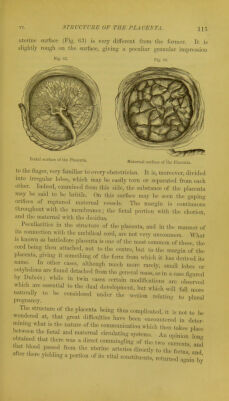
 No text description is available for this image
 No text description is available for this image
 No text description is available for this image