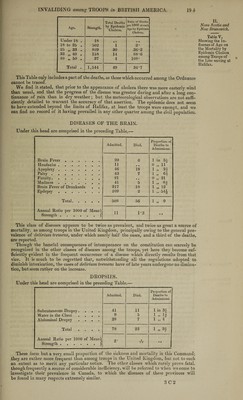
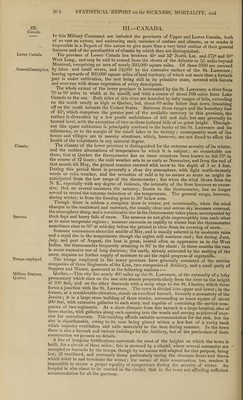
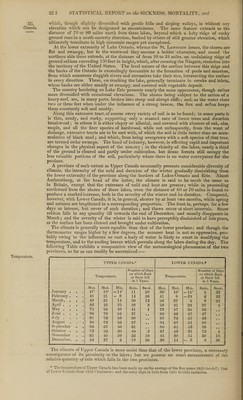
Statistical reports on the sickness, mortality, & invaliding among the troops in the United Kingdom, the Mediterranean, and British America / prepared from the records [by A.M. Tulloch, H. Marshall, and T.G. Balfour] of the Army Medical Department and War Office returns.
- Great Britain. Army Medical Services
- Date:
- 1839
Licence: Public Domain Mark
Credit: Statistical reports on the sickness, mortality, & invaliding among the troops in the United Kingdom, the Mediterranean, and British America / prepared from the records [by A.M. Tulloch, H. Marshall, and T.G. Balfour] of the Army Medical Department and War Office returns. Source: Wellcome Collection.
159/202 page 21
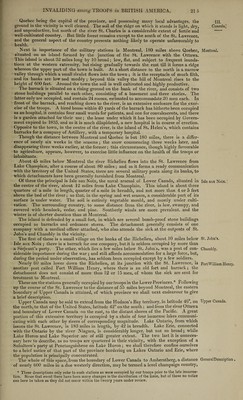
![Quebec being the capital of the province, arid possessing many local advantages, the ground in the vicinity is well cleared. The soil of the ridge on which it stands is light, dry, and unproductive, but north of the river St. Charles is a considerable extent of fertile anil well-cultivated country. But little forest remains except to the south of the St. Lawrence, and the general aspect of the country presents nothing likely to operate unfavourably to health. Next in importance of the military stations is Montreal, 180 miles above Quebec, situated on an island formed by the junction of the St. Lawrence with the Ottawa. This island is about 32 miles long by 10 broad; low, flat, and subject to frequent inunda¬ tions at the western extremity, but rising gradually towards the east till it forms a ridge whereon the upper part of the town is built. At a short distance to the north is a narrow valley through which a small rivulet flows into the town ; it is the receptacle of much filth, and its banks are low and muddy ; beyond this valley the hill of Montreal rises to the height of 600 feet. Around the town the soil is well cultivated and highly productive. The barrack is situated on a rising ground on the bank of the river, and consists of two stone buildings parallel to each other, consisting of a basement and three stories. The latter only are occupied, and contain 24 rooms, estimated to accommodate 20 men each. In front of the barrack, and reaching down to the river, is an extensive enclosure for the exer¬ cise of the troops. A hired house within 40 yards of the barrack has hitherto been occupied as an hospital, it contains four small wards for patients, and one for convalescents, and there is a garden attached for their use; the lease under which it has been occupied by Govern¬ ment expired in 1835, and as it is much dilapidated, a new hospital is in course of erection. Opposite to the town, in the centre of the river, is the island of St. Helen’s, which contains barracks for a company of Artillery, with a temporary hospital. Though the distance between Montreal and Quebec is but 180 miles, there is a differ¬ ence of nearly six weeks in the seasons ; the snow commencing three weeks later, and disappearing three weeks earlier, at the former; this circumstance, though highly favourable to agriculture, appears, however, to exercise little influence on the health of the troops or inhabitants. About 45 miles below Montreal the river Richelieu flows into the St. Lawrence from Lake Champlain, after a course of about 80 miles; and as it forms a ready communication with the territory of the United States, there are several military posts along its banks, to which detachments have been generally furnished from Montreal. Of these the principal is Isle aux Noix, the naval arsenal of Lower Canada, situated in the centre of the river, about 12 miles from Lake Champlain. This island is about three quarters of a mile in length, quarter of a mile in breadth, and not more than 4 or 5 feet above the bed of the river; so that, in the spring and wet season, a considerable part of its surface is under water. The soil is entirely vegetable mould, and mostly under culti¬ vation. The surrounding country, to some distance from the river, is low, swampy, and covered with hemlock, cedar, and pine. Southerly winds are more prevalent, and the winter is of shorter duration than at Montreal. The island is defended by a small fort, in which are several bomb-proof stone buildings occupied as barracks and ordnance stores. The detachment generally consists of one company with a medical officer attached, who also attends the sick at the outposts of St. John’s and Chambly in the vicinity. The first of these is a small village on the banks of the Richelieu, about 10 miles below Isle aux Noix ; there is a barrack for one company, but it is seldom occupied by more than a Serjeant’s party. The other, which lies a few miles below St. John’s, was a post of con¬ siderable importance during the war ; and still affords accommodation for a large force, but, during the period under observation, has seldom been occupied except by a few soldiers. Nearly 60 miles lower down the Richelieu, at its junction with the St. Lawrence, is another post called Fort William Henry, where there is an old fort and barrack; the detachment does not consist of more than 12 or 15 men, of whom the sick are sent for treatment to Montreal. These are the stations generally occupied by our troops in the Lower Provinces.* Following up the course of the St. Lawrence to the distance of 55 miles beyond Montreal, the eastern boundary ol Upper Canada is attained, of which province we shall next endeavour to give a brief description. Upper Canada may be said to extend from the Hudson’s Bay territory, in latitude 46°, on the north, to that of the United States, latitude 42° on the south ; and from the river Ottawa and boundary of Lower Canada on the east, to the distant shores of the Pacific. A great portion of this extensive territory is occupied by a chain of four immense lakes communi¬ cating with each other by rivers of corresponding magnitude. Lake Ontario, from which issues the St. Lawrence, is 183 miles in length, by 42 in breadth. Lake Erie, connected with the Ontario by the river Niagara, is considerably longer, but not so broad; while Lake Huron and Lake Superior are of still greater extent. The two last it is unneces¬ sary here to describe, as no troops are quartered in their vicinity, with the exception of a Subaltern’s party at Penetanguishene on Lake Huron ; we shall therefore confine ourselves to a brief notice of that part of the province bordering on Lakes Ontario and Erie, where the population is principally concentrated. The whole of this space, from the boundary of Lower Canada to Amherstberg, a distance of nearly 600 miles in a due westerly direction, may be termed a level champaign country, * These descriptions only refer to such stations as were occupied by our troops prior to the late insurrec¬ tion. Since that event there have been many changes in the distribution of the force, but of these no notice can here be taken as they did not occur within the twenty years under review. III. Canada.] Montreal. Isle aux Noix. St. John’s. Chambly. FortWilliam Henry. Upper Canada. GeneralDescription .](https://iiif.wellcomecollection.org/image/b30449625_0159.jp2/full/800%2C/0/default.jpg)