The cyclopaedia of practical medicine: comprising treatises on the nature and treatment of diseases, materia medica and therapeutics, medical jurisprudence, etc., etc (Volume 1).
- Date:
- 1849-59
Licence: Public Domain Mark
Credit: The cyclopaedia of practical medicine: comprising treatises on the nature and treatment of diseases, materia medica and therapeutics, medical jurisprudence, etc., etc (Volume 1). Source: Wellcome Collection.
Provider: This material has been provided by the National Library of Medicine (U.S.), through the Medical Heritage Library. The original may be consulted at the National Library of Medicine (U.S.)
104/822
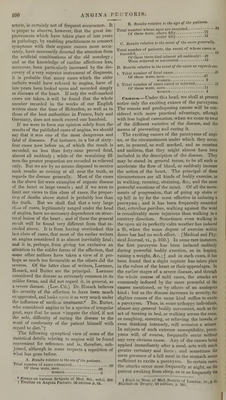
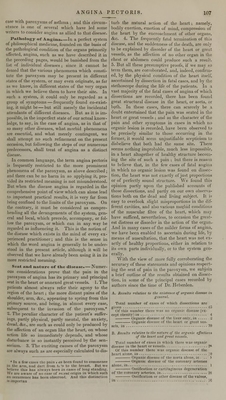
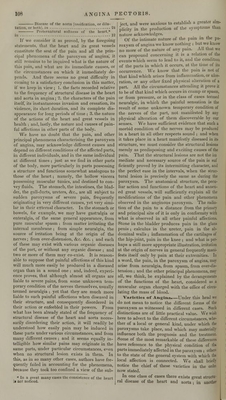
![article, is certainly not of frequent occurrence. It is proper to observe, however, that the great im- provements which have taken place of late years in pathology, hy enabling practitioners to connect symptoms with their organic causes more accu- rately, have necessarily diverted the attention from the artificial combinations of the old nosology ; and as the knowledge of cardiac affections has, moreover, been particularly increased by the dis- covery of a very superior instrument of diagnosis, it is probable that many cases which the older authors would have referred to angina, have of late years been looked upon and recorded simply as diseases of the heart. If only the well-marked cases are taken, it will be found that the whole number recorded in the works of our English writers since the time of Heberden, as well as in those of the best authorities in France, Italy and Germany, does not much exceed one hundred. If we were to form our opinion solely from the results of the published cases of angina, we should say that it was one of the most dangerous and fatal of diseases. For instance, in a list of sixty- four cases now before us, of which the result is recorded, no less than forty-nine proved fatal, almost all suddenly ; while of the remaining fif- teen the greater proportion are recorded as relieved only. But we are by no means disposed to receive such results as coming at all near the truth, as regards the disease generally. Most of the cases in the above list were examples of organic disease of the heart or large vessels ; and if we were to limit our views to this class of cases, the propor- tion of deaths above stated is probably less than the truth. But we shall find that a very large eloos of cases, legitimately ranged under the head of angina, have no necessary dependence on struc- tmal lesion of the heart; and of these the general result will be found very different from that re- corded above. It is from having overlooked this lant class of cases, that most of the earlier writers on angina considered it as almost inevitably fatal; and it is, perhaps, from giving too exclusive an attention to the milder forms of the affection, that some other authors have taken a view of it per- haps as much too favourable as the others did the reverse. Of the latter class of writers, Laennec, Hosack, and Butter are the principal. Laennec considered the disease as extremely common in its milder forms, and did not regard it, in general, as a KJvere disease. (Loc. Cit.) Dr. Hosack believes the severity of the affection to have been much ej iggcrated, and looks upon it as very much under the influence of medical treatment.* Dr. Butter, who considered angina to be a species of irregular gout, says that he must impute the chief, if not the sole, difficulty of curing the disease to the want of conformity of the patient himself with regard to diet.-)- The following synoptical view of some of the statistical details relating to angina will be found convenient for reference, and is, therefore, sub- joined, although in some respects a repetition of what has gone before. A. Results relative to the sez of the patients. Totul number of cases examined. gg Of these were, men gO women a * Essays on various Si-bjects of Med. Sei., vol ij 288 T Treatise on Angina Pectoris, 2d edition p. 24. B. Results relative to the age of the patients. Total number whose ages are recorded, Of these were, above fifty under fifty .64 C. Results relative to the event of the cases generally. Total number of patients, the event of whose cases is recorded, '■'■;;'.';;'' Of these there died (almost all suddenly). .49 Were relieved or recovered 15 D. Results relative to the event of the cases as regards sez. 1. Total number of fatal cases -iO Of these were, men 47 women 2 2. Total number of cases cured or relieved, 15 Of these were, men 11 women 4 Causes* Under this head, we shall at present notice only the exciting causes of the paroxysms. The remote and predisposing causes will be con- sidered with more practical advantage, athough with less logical catenation, when we come to treat of the different varieties of the disease, and the means of preventing and curing it. The exciting causes of the paroxysms of angi- na, or the circumstances under which they occur, are, in general, so well marked, and so constant and uniform, that they might almost have been included in the description of the disease. They may be stated in general terms, to be all such as accelerate the flow of blood, or suddenly increase the action of the heart. The principal of these circumstances are all kinds of bodily exercise, as in walking, running, straining, &c, and the more powerful emotions of the mind. Of all the move- ments of progression, that of going up stairs or up hill is by far the most effective in inducing a paroxysm ; and it has been frequently remarked that, ceteribus paribus, walking against the wind is considerably more injurious than walking in a contrary direction. Sometimes even walking in the open air in perfectly calm weather has induced a fit, when the same degree of exercise within doors has had no such effect. (Medical and Phy- sical Journal, vi., p. 320.) In some rare instances, the first paroxysm has been induced suddenly during powerful bodily exertion, as in leaping, raising a weight, &c.; j and in such cases, it has been found that a slight rupture has taken place in the valves of the heart or their appendages. In the earlier stages of a severe disease, and through the whole course of mild cases, the attacks are commonly induced by the more powerful ol the causes mentioned, or by others of an analogous kind ; but as the disease increases in severity, the slighter causes of the same kind suffice to excite a paroxysm. Thus, in some unhappy individuals, almost any .general bodily movement, such as the act of turning in bed, or walking across the room, or coughing, sneezing, or relieving the bowels, or even thinking intensely, will occasion a seizure In subjects of such extreme susceptibility, parox- ysms will, of course, frequently occur without any very obvious cause. Any of the causes being applied immediately after a meal, acts with much greater certainty and force ; and sometimes the mere presence of a full meal in the stomach seems sufficient to excite a paroxysm. In certain cas> the attacks occur most frequently at ni^ht, on th« patient awaking from sleep, as is so frequently the t Black in Mem. of Med. Society of London iv P B. Blackall on Dropsy, 2d edition, p. 3g.]t '](https://iiif.wellcomecollection.org/image/b21116805_0104.jp2/full/800%2C/0/default.jpg)