Licence: Public Domain Mark
Credit: On inflammation / by G. Thin. Source: Wellcome Collection.
Provider: This material has been provided by The Royal College of Surgeons of England. The original may be consulted at The Royal College of Surgeons of England.
53/88 (page 51)
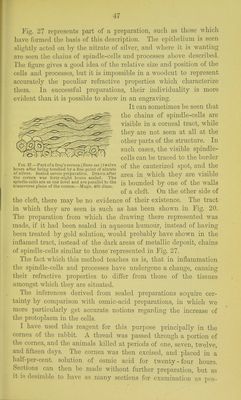
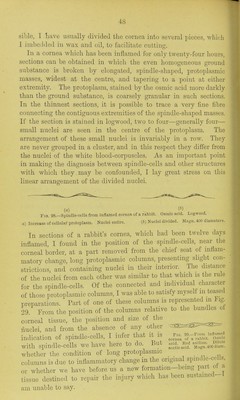
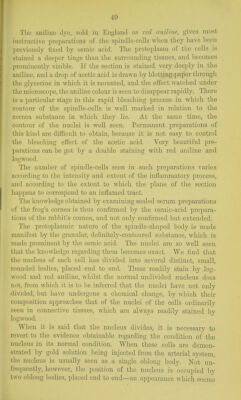
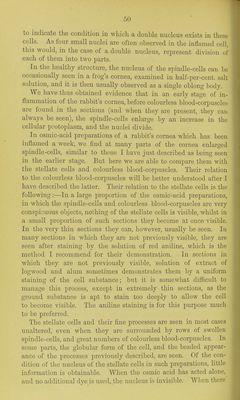
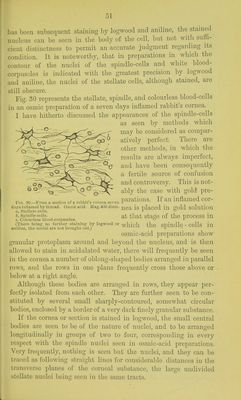
![lias l)ecn subsequent staining by logwood and aniline, the stained nucleus can be seen in the body of the cell, but not with suffi- cient distinctness to permit an accurate judgment regarding its condition. It is noteworthy, that in preparations in which the contour of the nuclei of the spindle-cells and white blood- corpuscles is indicated with the greatest precision by logwood and aniline, the nuclei of the stellate cells, although stained, are still obscure. Fig. 30 represents the stellate, spindle, and colourless blood-cells in an osmic preparation of a seven days inflamed rabbit's cornea. I have hitherto discussed the appearances of the spindle-cells as seen by methods which may be considered as compar- atively perfect. There are other methods, in which the results are always imperfect, and have been consequently a fertile source of confusion — ®0'^E^-^Jk' ^^^-^US- and controversy. Thisisnot- ® ^^^J^ ably the case with gold' pre- „ ,„ „ , parations. If an inflamed cor- Fio. 30.—From a section of a nibbit s oornea seven I days inflamed by thread. Oan.icacid. Mag.400 diam. j^g^ is placed ill ffold SOlutioU «, Stellate cells. ^ o 6, Spindle-cells. Q,t that stacje of the process in c. Colourless blood-corpuscles. (There beins no further staining by logwood or ^yl^ig]^ the Spiudle - Cells in aniline, the nnclei are not brought out.) J- osmic-acid preparations show granular protoplasm around and beyond the nucleus, and is then allowed to stain in acidulated water, there will frequently be seen in the cornea a number of oblong-shaped bodies arranged in parallel rows, and the rows in one plane frequently cross those above or below at a right angle. Although these bodies are arranged in rows, they appear per- fectly isolated from each other. They are further seen to be con- stituted by several small sharply-contoured, somewhat circular bodies, enclosed by a border of a very dark finely granular substance. If the cornea or section is stained in logwood, the small central bodies are seen to be of the nature of nuclei, and to be arranged longitudinally in groups of two to four, corresponding in every respect with the spindle nuclei seen in osmic-acid preparations. Very frequently, nothing is seen but the nuclei, and they can be traced as following straight lines for considerable distances in the iran.svcrse planes oC tlie corneal substance, the large undivided stellate nuclei being seen in the same tracts.](https://iiif.wellcomecollection.org/image/b22292743_0055.jp2/full/800%2C/0/default.jpg)