Licence: Public Domain Mark
Credit: On inflammation / by G. Thin. Source: Wellcome Collection.
Provider: This material has been provided by The Royal College of Surgeons of England. The original may be consulted at The Royal College of Surgeons of England.
9/88 (page 7)
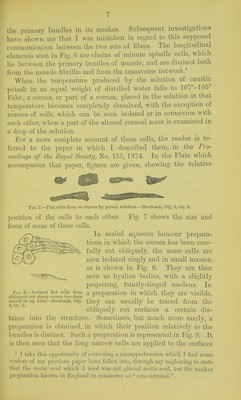
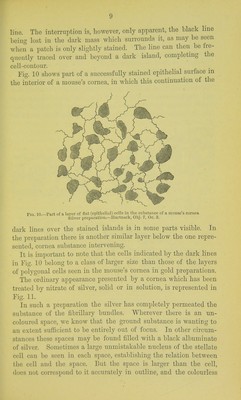
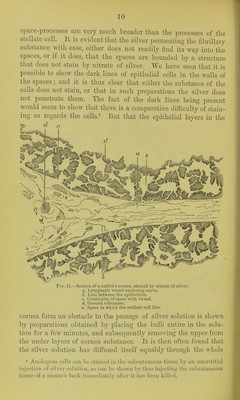
![the iniinavy Inimllcs in its ineslies. Subsequent investigations liiive shown nie tlmt I Avas mistaken in regard to this siii)posed communication between the two sets of fibres. Tlie longitudinal elements seen in Fig. 6 are chains of minute spindle cells, which lie between the primary bundles of muscle, and are distinct both from tlie muscle fibrilhc and from the transverse network.^ When the temperature produced by the solution of caustic potash in an equal wei nht of distilled water falls to 107°-105 Fahr., a cornea, or part of a cornea, placed in the solution at that tenqierature becomes completely dissolved, with the exception of masses of cells, which can be seen isolated or in connexion with each other, when a part of the altered corneal mass is examined in a drop of the solution. For a more complete account of these cells, the reader is re- ferred to the paper in which I described them, in the Pro^ ccedimjs of the Royal Society, No. 155, 1874 In the Plate which accompanies that paper, figures are given, showing the relative Fig. 7.—Flat cells from ox cornea hy potash solution.—Hartnack, Obj. 8, Oc. 3. position of the cells to each other. Fig. 7 shows the size and form of some of these cells. In sealed aqueous humour prepara- tions in which the cornea has been care- fully cut obliquely, the same cells are seen isolated singly and in small masses, as is shown in Fig. 8. They are then seen as hyaline bodies, with a slightly projecting, faintly-tinged niicleus. In Fio. 8.-Tsoiat(>(i flat cells from a preparation in which they are visible, ohliiiiiely cut slir«]) cornea two <Iays ^ ^ ./ j 8 oc's ''j- they can usually be traced from the obliquely cut surfaces ^ certain dis- tance into the structure. Sometimes, but much more rarely, a preparation is oljtained, in which their position relatively to the l)uii(lles is distinct. Such a preparation is represented in Fig. 9. It is then seen that the long narrow cells are applied to the surfaces ' I t<'ike tliis oj)i)nrtunity of correctiiig a misapprelieiiBion wliicli I find some i i-adcM of iny piuvioim pupcr liave fallen into, tlivongh my neglecting to state lliat the acdic arid which I used Avas not glacial acetic acid, Init the weaker lircparation known in England in coninierce as conceiitiated.](https://iiif.wellcomecollection.org/image/b22292743_0011.jp2/full/800%2C/0/default.jpg)