Report of the surgical operations performed at the Newcastle-upon-Tyne Infirmary during a period of seventeen years and a half. Pt. 1, On amputations of the limbs / by Samuel Fenwick.
- Samuel Fenwick
- Date:
- 1848
Licence: Public Domain Mark
Credit: Report of the surgical operations performed at the Newcastle-upon-Tyne Infirmary during a period of seventeen years and a half. Pt. 1, On amputations of the limbs / by Samuel Fenwick. Source: Wellcome Collection.
53/64 (page 53)
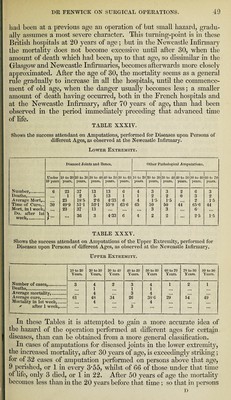
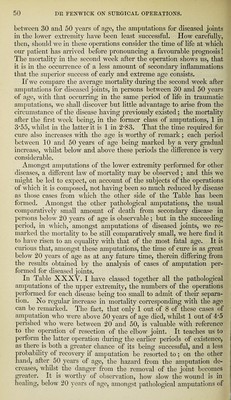
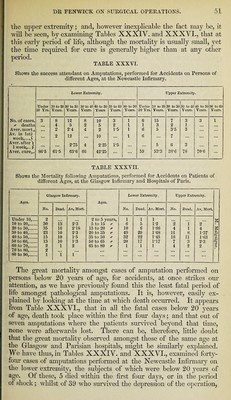
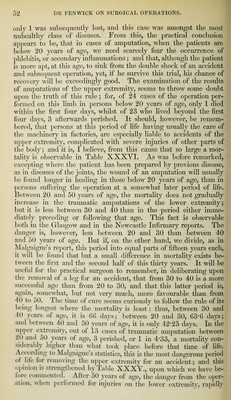
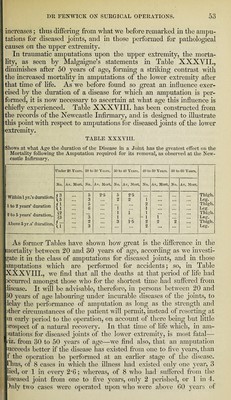
![increases; thus differing from what we before remarked in the ampu¬ tations for diseased joints, and in those performed for pathological causes on the upper extremity. In traumatic amputations upon the upper extremity, the morta- %> as seen by Malgaigne’s statements in Table XXXVII., diminishes after 50 years of age, forming a striking contrast with the increased mortality in amputations of the lower extremity after that time of life. As we before found so great an influence exer¬ cised by the duration of a disease for which an amputation is per¬ formed, it is now necessary to ascertain at what age this influence is chiefly experienced. Table XXXVTII. has been constructed from the records of the Newcastle Infirmary, and is designed to illustrate this point with respect to amputations for diseased joints of the lower I extremity. TABLE XXXVIII. Shows at what Age the duration of the Disease in a Joint has the greatest effect on the Mortality following the Amputation required for its removal, as observed at the New¬ castle Infirmary. Within 1 yr.’s duration, 1 1 to 2 years’ duration 2 to 5 years’ duration,. Above 5 yr.s’ duration, Under 20 -Years. 20 to 30 Years. 30 to 40 Years. 40 to 50 Years. 50 to 60 Years, No. Av, Mort, No. Av. Mort, No. Av, Mort, No. Av, Mort, No. Av. Mort. ( 3 5 2-5 5 2-5 \5 3 2 2 i f 1 5 ... ... 2 U 6 1 ... -1 52 • • • ] 1 1 (3 3 1 ... - 1 i ( ... 2 3 1-5 2 2 2 u 3 ... ... 2 • • • ... Thigh. Leg. Thigh. Leg. Thigh. Leg. Thigh. Leg. As former Tables have shown how great is the difference in the inortality between 20 and 30 years of age, according as we investi¬ gate it in the class of amputations for diseased joints, and in those I amputations which are performed for accidents; so, in Table IXXXVIII., we find that all the deaths at that period of life had I Occurred amongst those who for the shortest time had suffered from llisease. It will be advisable, therefore, in persons between 20 and 130 years of age labouring under incurable diseases of the joints, to jlelay the performance of amputation as long as the strength and I Jther circumstances of the patient will permit, instead of resorting at I m early period to the operation, on account of there being but little I irospect of a natural recovery. In that time of life which, in am- I rotations for diseased joints of the lower extremity, is most fatal— ldz. from 30 to 50 years of age—we find also, that an amputation I succeeds better if the disease has existed from one to five years, than |f the operation be performed at an earlier stage of the disease, finis, of 8 cases in which the illness had existed only one year, 3 lied, or 1 in every 2*6; whereas, of 8 who had suffered from the jliseased joint from one to five years, only 2 perished, or 1 in 4. I Only two cases were operated upon who were above 60 years of](https://iiif.wellcomecollection.org/image/b30559959_0053.jp2/full/800%2C/0/default.jpg)