Atlas and epitome of diseases of children / by R. Hecker and J. Trumpp ; edited by Isaac A. Abt.
- Rudolf Hecker
- Date:
- 1907
Licence: In copyright
Credit: Atlas and epitome of diseases of children / by R. Hecker and J. Trumpp ; edited by Isaac A. Abt. Source: Wellcome Collection.
36/586 (page 24)
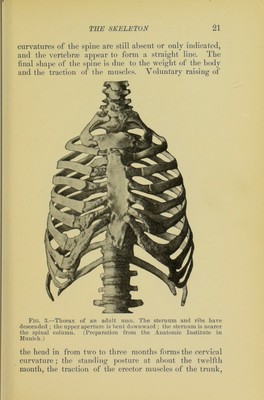
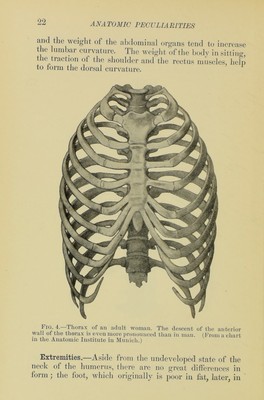
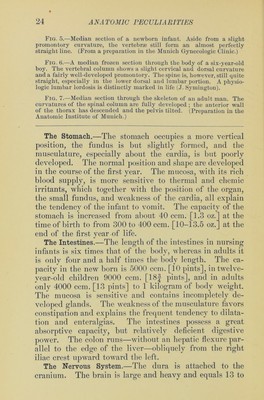
![Fig. 5.—Median section of a newborn infant. Aside from a slight promontory curvature, the vertebne still form an almost perfectly straigbt line. (From a preparation in the Munich Gynecologic Clinic.) Fig. 6.—A median frozen section through the body of a six-year-old boy. The vertebral column shows a slight cervical and dorsal curvature and a fairly well-developed promontory. The spine is, liowever, still quite straight, especially in the lower dorsal and 1 umbar portion. A Physio- logie lumbar lordosis is distinctly rnarked in life (J. Symington). Fig. 7.—Median section through the skeleton of an adult man. The curvatures of the spinal column are fully developed ; the anterior wall of the tkorax has descended and the pelvis tilted. (Preparation in the Anatomie Institute of Munich.) The Stomach.—The stomacli occupies a more vertical position, the fundus is but slightly formed, and the musculature, especially about the cardia, is but poorly developed. The normal position and shape are developed in the courseof the first year. The mucosa, with its rieh blood supply, is more sensitive to thermal and chemic irritants, which together with the position of the organ, the small fundus, and weakness of the cardia, all explain the tendency of the infant to vomit. The capacity of the stomach is increased from about 40 ccm. [1.3 oz.l at the time of birth to from 300 to 400 ccm. [10-13.5 oz. at the end of the first year of life. The Intestines.—The length of the intestines in nursing infants is six times that of the body, whereas in adults it is only four and a half times the body length. The ca- pacity in the new born is 5000 ccm. [10 pints], in twelve- vear-old children 9000 ccm. [18f pints], and in adults only 4000 ccm. [13 pints] to 1 kilogram of body weight. The mucosa is sensitive and contains incompletely de- veloped glands. The weakness of the musculature favors constipation and explains the frequent tendency to dilata- tion and enteralgias. The intestines possess a great absorptive capacity, but relatively deficient digestive power. The colon runs—without an hepatic flexure par- allel to tlie edge of the liver—obliquely from the right iliac crest upward toward the left. The Nervous System.—The dura is attached to the cranium. The brain is large and heavy and equals 13 to](https://iiif.wellcomecollection.org/image/b28128540_0036.jp2/full/800%2C/0/default.jpg)