Atlas and epitome of diseases of children / by R. Hecker and J. Trumpp ; edited by Isaac A. Abt.
- Rudolf Hecker
- Date:
- 1907
Licence: In copyright
Credit: Atlas and epitome of diseases of children / by R. Hecker and J. Trumpp ; edited by Isaac A. Abt. Source: Wellcome Collection.
47/586 (page 35)
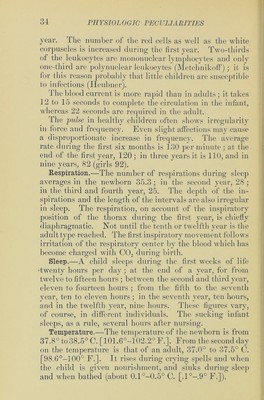
![Hont production and lieat dissemination are greater in a cliild than in an adult. According to Vicrordt the ratio is as follows : 1 kg. of body weight of the newborn 130,000 calories. 1 kg. of body weight of one and a half years .... 91,000 “ 1 kg. of body weight of an adult 39,000 The greater degree of lieat dissemination depends upon the relatively larger amount of surface, the more rapid circulation, and the increased respiration rate. Excretion of Urine.—The urinc is already exercted in utero. It is scarce during the tirst tvvo days of life, and tlien increases in proportion to the amount of fluid in- gcsted. Wlien 100 gm. of milk are taken, the urinary output amounts to 60 to 70 gm. (Bendix). The daily amount of urine secreted is as follows: first day, 17 gm.; second to third day, 40 to 50 gm.; cighth day, 250 gm.; six months, 500 to 600 gm.; after which it rises to one liter during the years of puberty. The urine during the first days of life contains albumin, tubulär casts, and crystals of uric acid. (For examination of urine, see Renal Diseases.) Special Senses.— T rision.—Newborn infants are sen- sitive to light and cannot bear diffuse daylight until after the second or third week. Light and dark are distin- guished after a few days. Objects can be foeussed after fonr or five weeks. Primarily the eye is myopie because of greater curvature of tlie cornea. [Some authors main- tain that the eye is hypermetropic durine: the first days of life.—Ed.] * ' Hearing.—Deafnessexists during the first twenty-four to thirty-six liours, because of swellingof the mucous mem- brane of the middle ear. In the course of a few weeks tiie infant hears noises; during the whole first yeara dis- agreeable Sensation is produced by slirill tones and noises. The otlier special senses are dcveloped, witli the exception of the sense of spaee, which beeomes functional witli the enlarged experiences of later childhood. Movements.—The first movements are reflex and auto-](https://iiif.wellcomecollection.org/image/b28128540_0047.jp2/full/800%2C/0/default.jpg)