Clinical diagnosis : the bacteriological, chemical, and microscopical evidence of disease / by Rudolf v. Jaksch ; translated from the second German edition by James Cagney ; with an appendix by Wm. Stirling.
- Cagney James.
- Date:
- 1890
Licence: Public Domain Mark
Credit: Clinical diagnosis : the bacteriological, chemical, and microscopical evidence of disease / by Rudolf v. Jaksch ; translated from the second German edition by James Cagney ; with an appendix by Wm. Stirling. Source: Wellcome Collection.
Provider: This material has been provided by the Royal College of Physicians of Edinburgh. The original may be consulted at the Royal College of Physicians of Edinburgh.
37/432 (page 9)
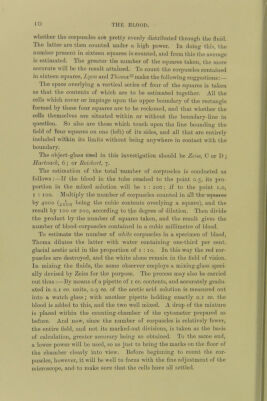
![ENUMERATION OF BLOOD-CORPUSCLES. IIIoocl from the auimnit of tlio exuding dro]) i.s then sucked into the tube until it reaches the mark 0.5 or i. The point of the tube is wiped, and a 3 per cent, solution of common salt sucked in until the fluid has risen to the point marked loi. The contents of the tube are then thoroughly mixed, and the column of fluid in the capillary tube is removed by blowing into the tube, as the blood would not mix with the solution of common salt. To neglect this precaution, therefore, would vitiate the experiment. Ihe capillary tube must bo carefully cleaned after use, by washing it with distilled water, then with alcohol, and finally with aether, and a brisk current of air blown through it. For the latter purpose Bohni’s air-pump is very suitable. < 0 “ 0 0 «• {”0 P 00 ® 0 e «* 0 0 r p % . 0 »'' e ©o 9 ° 0 ® 0 0 ® c 0 0 e 0 a D e e 0 ^ 0 Oo® ^ 0 a 0 e u ® 0 0 0 0 0 0 0 0 ®o 0 c 0 « P 0 0 0 0 e 0 0 0 D 0 e Of, 0 • ® 0 0 0 0 o 0 •0 P 0 0 0 wo* » 0 0 0' « 0 0 « 0 e e 00 ® o« « 0 ® e r> « • *. 00* • 0 9 0 « * 0 0 0 0 e 0 0 ■ 0 • «.o 9 ® • n 0 0 e^o Fio. 5.-Thoni.vZoi.ss Appar.itus for Counting Blood-Corpuscles. The hollow cell of the slide is next filled with the mixed blood- and-salt-solution, care being taken to guard against the admission of air-bubbles, and the cover glass is accurately adjusted in such a manner that Newton’s colour-rings are produced. The preparation IS left to stand for some minutes, so as to allow of an intimate ad- mixture of Its parts, after which it is placed under the microscope, and looked at with a power of 30-70 diameters, when it will be seen whether any air-bubbles or foreign bodies are present in it, and](https://iiif.wellcomecollection.org/image/b21699574_0037.jp2/full/800%2C/0/default.jpg)