Vital statistics : a memorial volume of selections from the reports and writings of William Farr / edited for the Sanitary Institute of Great Britain by Noel A. Humphreys.
- William Farr
- Date:
- 1885
Licence: Public Domain Mark
Credit: Vital statistics : a memorial volume of selections from the reports and writings of William Farr / edited for the Sanitary Institute of Great Britain by Noel A. Humphreys. Source: Wellcome Collection.
Provider: This material has been provided by London School of Hygiene & Tropical Medicine Library & Archives Service. The original may be consulted at London School of Hygiene & Tropical Medicine Library & Archives Service.
99/600 (page 67)
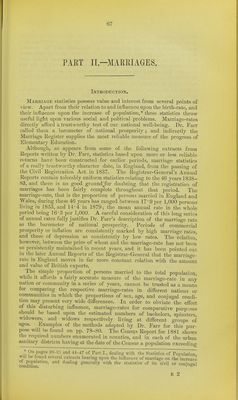
![PART II.—MARRIAGES. Introduction. Marriage statistics possess value and interest fi-om several points of view. Apart from their relation to and influence upon the birth-rate, and their influence upon the increase of population,* these statistics throw useful light upon various social and political problems. Marriage-rates directly afford a trustworthy test of our national well-being. Dr. Farr called them a barometer of national prosperity; and indirectly the Marriage Eegister supplies the most reliable measure of the progress of Elementai-y Education. Although, as appears from some of the following extracts from Reports written by Dr. Farr, statistics based upon more or less reliable returns have been constructed for earlier periods, marriage statistics of a really trustworthy character date, in England, from the passing of the Civil Registration Act in 1837. The Registrar-G-eneral's Annual Reports contain tolerably uniform statistics relating to the 46 years 1838- 83, and there is no good groundjfor doubting that the registration of marriages has been fairly complete throughout that period. The marriage-rate, that is the proportion of persons married in England and Wales, during these 46 years has ranged between 17 9 per 1,000 persons living in 1853, and 14-4 in 1879; the mean annual rate in the whole period being 16-3 per 1,000. A careful consideration of this long series of annual rates fully justifies Dr. Farr's description of the marriage rate as the barometer of national prosperity. Periods of commercial prosperity or inflation are consistently marked by high marriage rates, and those of depression as consistently by low rates. The relation] however, between the price of wheat and the marriage-rate has not been so persistently maintained in recent years, and it has been pointed out in the later Annual Reports of the Registrar-General that the marriao-e- rate in England moves in far more constant relation with the amount and value of British exports. The simple proportion of persons married to the total population, while it affords a fairly accurate measure of the marriage-rate in any nation or community in a series of years, cannot be trusted as a means for comparing the respective marriage-rates in different nations or communities in v/hich the proportions of sex, age, and conjugal condi- tion may present very wide differences. In order to obviate the effect of this disturbing influence, marriage-rates for comparative purposes should be based upon the estimated numbers of bachelors, spinsters, widowers, and widows respectively living at different groups of ages. Examples of the methods adopted by Dr. Farr for this pur- pose will be found on pp. 78-80. The Census Report for 1881 shows the required numbers enumerated in counties, and in each of the urban sanitary districts having at the date of the Census a population exceeding * On pages 20-21 and 44-47 of Part I., dealing with the Statistics of Population wiu be louiid several extracts bearing upon the influence of marriage on the increase ot population, and dealing generally with the statistics of its civil or coninrrnl condition. ^ E 2](https://iiif.wellcomecollection.org/image/b21364333_0099.jp2/full/800%2C/0/default.jpg)