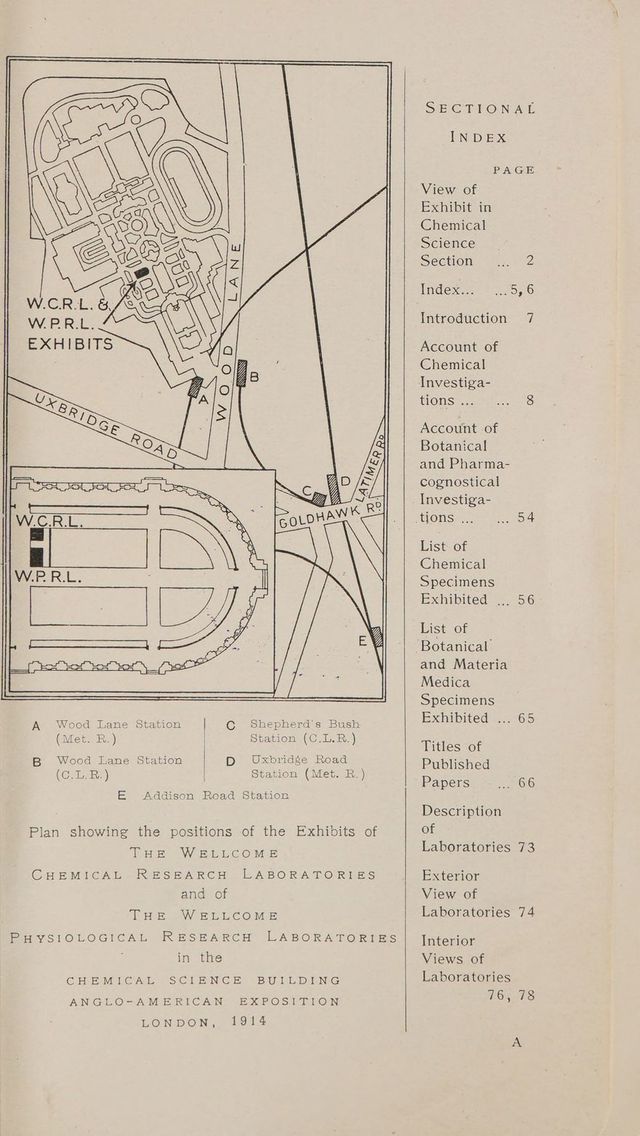
The Wellcome Chemical Research Laboratories exhibit at the Anglo-American Exposition, London, 1914.
- Wellcome Chemical Research Laboratories
- Date:
- 1914?]
Licence: Public Domain Mark
Credit: The Wellcome Chemical Research Laboratories exhibit at the Anglo-American Exposition, London, 1914. Source: Wellcome Collection.
40/84 page 38
![particular substances in these leaves cannot be confirmed, while, on the other hand, certain products to which distinctive names had been assigned have been shown to consist of indefinite mixtures. The material employed for investigation consisted of (1) Tinnevelly senna leaves; (ii) Senna leaves from Peru, which were found to be botanically identical with the Tinnevelly leaves; and (iii) Alexandrian senna leaves. . The Tinnevelly leaves yielded a small amount of an essential oil ; salicylic acid; rhein, C;;H,O,; kaempferol, C,;H,O0,; aloe-emodin,C,;H 1,033 Laempferin,Co,H390}5,6H2O, a new glucoside of kaempferol ; a mixture of the glucosides of rhein and aloe-emodin ; the magnesium salt of an unidentified organic acid ; myricyl alcohol ; a phytosterol, C.,H,,0 ; a phvtosterol glucoside, C33,H;,0, ; and palmitic and stearic acids. The leaves also contained a quantity of sugar, together with some amorphous, glucosidic material. The senna leaves from Peru were found to contain all the above-mentioned compounds, with the exception of the magnesium salt, and, in addition, zsorhamnetin. Alexandrian senna leaves yielded, in addition to myricy] alcohol and a phytosterol glucoside, rhein, aloe-emodin, kaempferol, and ¢sorhamnetin. The four last-mentioned substances were also present in the form of glucosides, and in much larger proportion as such than in the free state (Journ. Chem. Soc., 1913, 103, pp. 2006-2023). ANTHRAQUINONE DERIVATIVES The investigation of certain anthraquinone derivatives occurring in nature has included an examination of commercial chrysarobin, which, for many years, was supposed to be chrysophanic acid. In this connection the constitution of chrysophanic acid and emodin, and that of barbaloin, have been made the subjects of special study (Journ. Chem. Soc., 1902, 81, pp. 1575-1585; 1903, 83, PP. 1327-1334; 1905, 87, pp. 878-884).](https://iiif.wellcomecollection.org/image/b33446969_0040.jp2/full/800%2C/0/default.jpg)


 No text description is available for this image
 No text description is available for this image
 No text description is available for this image