Licence: Public Domain Mark
Credit: First lines of the practice of physic (Volume 2). Source: Wellcome Collection.
Provider: This material has been provided by the National Library of Medicine (U.S.), through the Medical Heritage Library. The original may be consulted at the National Library of Medicine (U.S.)
17/300
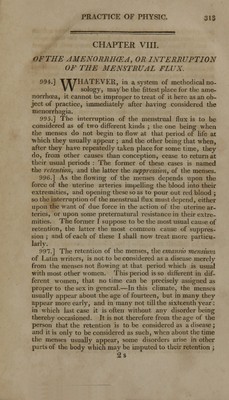
![CHAPTER VIII. OF THE AMENORRHEA, OR INTERRUPTION OF THE MENSTRUAL FLUX. 994.] IT7HATEVER, in a system of methodical no- V V sology, may'be the fittest place for the ame- norrhoea, it cannot be improper to treat of it here as an ob- ject of practice, immediately after having considered the menorrhagia. 995.] The interruption of the menstrual flux is to be considered as of two different kinds ; the one being when the menses do not begin to flow at that period of life at which they usually appear ; and the other being that when, after they have repeatedly taken place for some time, they do, from other causes than conception, cease to return at their usual periods : The former of these cases is named the retention, and the latter the suppression, of the menses. 996.] As the flowing of the menses depends upon the force of the uterine arteries impelling the blood into their extremities, and opening these so as to pour out red blood ; so the interruption of the menstrual flux must depend, either upon the want of due force in the action of the uterine ar- teries, or upon some preternatural resistance in their extre- mities. The former I suppose to be the most usual cause of retention, the latter the most common cause of suppres- sion ; and of each of these I shall now treat more particu- larly. 997.] The retention of the menses, the emansio mensiuvi of Latin writers, is not to be considered as a disease merely from the menses not flowing at that period which is usual with most other women. This period is so different in dif- ferent women, that no time can be precisely assigned as proper to the sex in general.—In this climate, the menses usually appear about the age of fourteen, but in many they appear more early, and in many not till the sixteenth year: in which last case it is often without any disorder being thereby occasioned. It is not therefore from the age of the person that the retention is to be considered as a disease; and it is only to be considered as such, when about the time the menses usually appear, some disorders arise in other parts of the body which may be imputed to their retention ; 2s](https://iiif.wellcomecollection.org/image/b21112277_0017.jp2/full/800%2C/0/default.jpg)