Volume 2
Bibliotheca chemica : a catalogue of the alchemical, chemical and pharmaceutical books in the collection of the late James Young of Kelly and Durris ... / by John Ferguson.
- Andersonian Library
- Date:
- 1906
Licence: In copyright
Credit: Bibliotheca chemica : a catalogue of the alchemical, chemical and pharmaceutical books in the collection of the late James Young of Kelly and Durris ... / by John Ferguson. Source: Wellcome Collection.
21/614 page 11
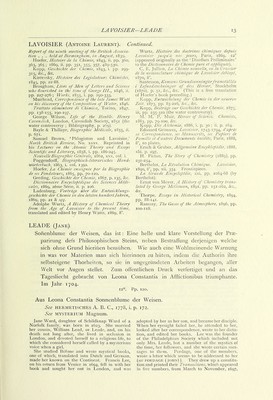
![LASNIORO (Joannes de). Continued. Deus juvit me.' Doubtless he thought himself well out of it. According to Petraeus these revelations are con- tained in a MS. on vellum of date 1440, entitled Via Universalis. It is to be observed, however, that the title Via Universalis is given to the present tract, for it concludes with the following paragraph ; ' E.xplicit via universalis Joannis de Lasnioro Lazon. sub Anno millesimo quadringentesimo quadragesimo octavo. Feria Sexta in Vigilia Viti. Ego verb Joannes Lucianus exemplavi diligentia magna, anno quadringentesimo.' As the passages relative to the Queen, quoted by Petraeus from the vellum MS., dated 1440, of the Via Universalis, do not occur in the present tract. Van der Linden, De Scriftis Medicis libri duo, 1637, p. 286. Mercklin, Lindenius renovatus, 1686, p. 626. Manget, Bibliotheca Scriptorum Medicorum, 17.31. II- '• P. 44- Lenglet Dufresnoy, Uistoire de la Philosophte HermMque, 1742, iii. pp. 54, 201. Petraeus, Fr. Basilii Valenti/ii . . . Chymische Schriften, 1769, Neue Vorrede, sig. da recto. Beytrag zur Geschichte der hohern Chcmie, 1785, P- 583- we must infer either that there are two distinct works of the same name, or, more likely, that the printed version as we now have it is not complete. The Tractatus Aureus appeared in 1611 in Tractatus de Secretissimo Antiquorum Pkiloso- phorum Arcano. Tractatus ii. De Lapide Philo- sophorum Joannis Lasniori Bohsemi Summi Philosophi, nunc primum in gratiam studiosae juventutis in lucem editas (sic) ab Autore Anonymo. Anno TV es saCerDos In aeternVM., small 8°. sig. A. This tract was published again in 1612, 8'“, and with others at Hanau, 1618, 8°. It was reprinted in the Theatrum Chemicum, 1613, iv. p. 657, and in the later edition of 1659, as above. If all this be accurate, the present tract must have been composed about 1437. Semler, Unparteiische Samlungen zur Historic der Rosenkreuzer, 1787, ii. p. 29. Gmelin, Geschichte der Chemie, 1797, i. p. 296. Fuchs, Repertorium der chcmischcn Litteratur, 1806-08, p. 106. Jocher, Allgemeines Gelehrten-Lexicon; Roter- mund’s Fortsetzung und Frgdnzungen, 1810, iii. col. 1320. Schmiedcr, Geschichte der Alchemic, 1832, p. 223. Kopp, Die Alchemie, 1886, i. p. 160; ii. p. 383. LAUGIER (Robert de). Institutiones Pharmaceuticse sive Philosophia Pharmaceutica Auctore Roberto de Laugier Doct. Med. S. C. Maj. Consiliar. Universitat. Vindobon. <5c Mutin. Chemiae & Botanices Professore Emerito, Reg. Nancei'ante, & Georgo- phil. Florentin. Academiar. Socio, atque Mulinensi Medicorum Collegio adscripto. Mutinae M DCC LXXXVIII. Apud Societatem Typographicam. Annuentibus Superioribus. 8°. Pp. 326 [2]. 6 plates of Laugier's still. This is the first volume only. There should be three in all, 1788-1791, 8°. Though his name is quite distinctly Robert, Poggendorff calls him Franfois. He is reported as a native of Nancy or of Metz. He was a doctor of medicine, imperial councillor, professor of chemistry and botany at Vienna and at Modena, a member of the Royal Society of Nancy, of the Agricultural Society of Florence, and of the College of Physicians at Modena. After he resigned his chair in 1768 he lived at Strassburg, and ou 17 Dec., 1793, flicd tit Reggio. The above is apparently his only work, but he is remembered by the distilling apparatus which he invented. He is not to be confu.scd with .■\ndrd Laugier, who succeeded Fourcroy at the Museum of Natural History as professor of chemistry, and devoted himself to the analysis of minerals. Poggendorff, Biographisch-literarisches Handworfcrbuch, 1863, i. eol. 1383. L.‘\VINIUS (Wenceslaus) Moravus. Tractatus de Coelo Terrestri. See HAPELIUS (NICOLAUS NIGER), Cheiragogia Heliana, 1612, j). 97. See THEATRUM CHEMICUM, 1659, iv. p. 288. Traits du ciel terrestre. See RICHEBOURG (j. M. D.), Bibliotlieque des Philosophes Chiniiques, 1754, iv. p. 566. These three tracts are quoted by Lenglet Du- fresnoy, who repeats that the author was a Moravian gentleman, and that his ‘ Traitb' though short was esteemed. He is said to have studied at foreign universities, lived in Paris, and returned to his own country in possession of the stone, which, from the quantity he possessed, he seemed to have had the secret of making. Oswald Crollius in a note to Mining Superintendent Franz Kretschmer savs he had seen the red powder, and, though he knew Lavinius familiarly in France and was aware of his working at chemistry, he was doubtful about his being .able to transmute the metals.](https://iiif.wellcomecollection.org/image/b29001559_0002_0021.jp2/full/800%2C/0/default.jpg)
 No text description is available for this image
 No text description is available for this image
 No text description is available for this image