Volume 2
A dictionary of arts and sciences / [G. Gregory].
- George Gregory
- Date:
- 1806-1807
Licence: Public Domain Mark
Credit: A dictionary of arts and sciences / [G. Gregory]. Source: Wellcome Collection.
18/1082 page 4
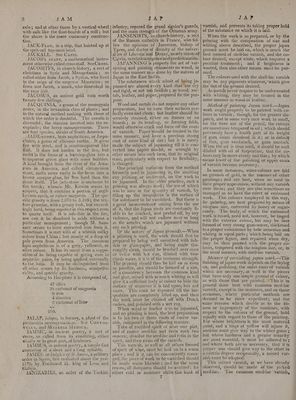
![‘4: SUAS T styles; the capsule is trilocular, with one seed in each cell. ‘There are nine species, of which the most remarkable are: 1. The cur- cas, or English. physic-nut, with leaves cor- date and angular, is a knotty shrub growing about 10 or 12 feet high. The extremities of the branches are covered with leaves; and the flowers, which are of a green herbaceous kind, are set on in an umbel fashion round the extremities of the branches, but especially the main stalks. These are succeeded by as many nuts, whose outward tegument is green and husky, which being peeled off discovers the nut, whose shell is black, and easily erack- ed; this contains an alimond-like kernel, di- vided into two parts, betweed which separa- tion lie two milk-white thin membranaceous leaves, easily separable from each other. These have not only a bare resemblance of perfect leaves, but have in particular every part, the stalk, the middle rib, and transverse ones, as visible as any leaf whatsoever. 2. The gossypifolia, cotton-leaved jatropha, or belly- ache bush, the leaves of which are quinque- partite, with lobes ovate and entire, and glan- duiar branchy bristles. he stem, which is covered with a light-greyish bark, grows to about three or four feet high, soon dividing ynto several wide-extended branches. From among these rise several small deep-red pen- tapetalous flowers, the pistil of each being thick-set at the top with yellow farinaceous dust, which blows off when ripe. These tlowers are succeeded by hexagonal husky blackish berries, which, when ripe, open by the heat of the sun, emitting a great many small dark-coloured seeds, which serve as food for ground doves. 3. ‘The multifida, or French physic-nut, with leaves many-parted and polished. ‘The flowers of this grow in bunches, umbel fashion, upon the extremi- ties of each large stalk, very much resem- bling, at their first appearance, a bunch of red coral: these afterwards open into small tive-leaved purple flowers, and are succeeded by nuts, which resemble thase of the first species. 4. The manihot, or bitter cassada, fas palmated leaves; the lobes lanceolate, very entire, and polished. 5. The janipha, “or sweet cassada, has palmated leaves, with Jobes very entire; the intermediate leaves Sobed with a sinus on both sides. 6. The elas- tica, .with ternate leaves, elliptic, very entire, hoary underneath, and longly petiolied. See figures of the two last in plate 22, which ren- <iers a more particular description unneces- sary. - ‘ ‘The root of bitter cassada has no fibrous or woody filaments in the heart, and neither boils nor roasts soft. The sweet cassada has ali the opposite qualities. The bitter, how- ever, may be deprived of its noxious quali- sada bread, therefore, is made of both the bitter and sweet, thus: the roots are washed aud scraped clean, then grated into. a tub or trough; after this they are put into a hair bag, and strongly pressed with a view to squeeze out the juice, and. the meal or farina is dried in a hot stone bason over the fire; it is then made. into cakes. It also makes ex- cellent puddings, equa] to millet. The scrap- ings of fresh bitter cassada are successfully applied to ill-disposed ulcers. Cassada roots yield a. great quantity of starch, which the Brasilians export in little lumps under the name of tapioca, : CH bat, the smallest bits of manioc which hdve escaped the grater, and the clods which have not passed the sieve, are not useless. They are dried in the stove after the flour is roast- ed, and then pounded in a mortar to a fine white powder, with which they make soup. It is likewise used for making a kind of thick coarse cassada, which is roasted till almost burnt; of this, fermented with melasses and West India potatoes, they prepare a much esteemed drink or beverage cailed ouycou. This liquor, the favourite drink of the na- tives, is sometimes made extremely strong, especially on any great occasion, as a feast: with this they get intoxicated, and remem- bering their old quarrels, massacre and mur- der each other. Such of the inhabitants and workmen as have not wine, drink ovycou. It is of a red colour, strong, nourishing, re- freshing, and easily inebriates the, inhabi- tants, who soon accustom themselves to it as easily as beer. The 6th species is the hevea guianensis of Aublet, or tree which yields the elastic resin called caoutchouc, or India rubber : for a par- ticular account of which see CaouTcHove. The figure we have given is copied from Aublet’s tab. 335, and not fromthe erroneous plate given in the Acta Parisiana. JAU-RATA. ‘See Rayania. JAUNDICE. See MepIcINE. JAW. See ANaTomy. -IBERIS, sciatica cresses, or candy-tuft, a genus of the siliquosa order, in the tetradyna- inia class of plants, and in the natural method ranking under the 39th order, siliquose. ‘The corolla is regular; the two exterior petals larger than the interior ones; the silicula polyspermous, eniarginated. . There are 14 species. ‘The most remarkable are: 1. The umbellata, or common candy-tuft, a weill- known annual. 2. The amara; or bitter candy-tuft. 3. The sempervirens, commonly called tree candy-tuft. “4. The semper- florens, with white flowers in umbels at the ends of the branches, appearing at all times of the year. IBEX, in zoology. See CAPRA. IBIS. See TAnTaus, ICE. See Water, and Corp. Ice-HousE, a building contrived to pre- serve ice for the use of a family in the sum- mer season. It is generally sunk some feet in the ground in a very shady situation, and covered with thatch. ICELAND-AGATE, a precious stone met with in the islands of Iceland and Ascen- sion, employed by the jewellers as an agate, though too soft for the purpose. It is sup- posed to be a volcanic product; being solid, black, and of a glassy texture. When held between the eye and the light, it is semitrans- parent, and greenish, like the glass bottles Iwhich contain. much iron. In the islands which produce it, such large pieces are met with that they cannot be equalled in any glass- house. ICHNEUMON jy, the name of a genus of flies of the hymenoptera order. ‘The ge- neric character is, mouth with jaws, without tongue; antenne with more than thirty joints; abdomen in most species footstalked , piercer exserted, with a cylindric bivalve sheath. he animals of this genus provide for the support of their offspring in a manner highly extraordinary, depositing their eggs in nn I:c O the bodies of other: living insects, and gene- rally in those of caterpillars. ‘hese eggs in a few days hatch, and the young larvz, which resemble minute white maggots, . nourish themselves with the juices of the unfortunate animal, which however continues to move about and feed till near the time ofits change to a chrysalis, when the young brood of ich- neumon-larve creep out by perforating the skin in various places, and each spinning it- self up in a small oval silken case, changes into a chrysalis, the whole number forming a groupe on the shrivelled body of the cater- pillar which had atiorded them nourishnent; and after a certain pericd emerge in the state of complete ichneumons. ees It was the want of an exact knowledge of the genus ichneumon that proved so conside- rable an emibarrassuient to the older entomo- logists,who having seen a brood of ichnewmnens proceed trom the chi ysalis ofa buitertiy, could not but conclude that the production oi insects was rather a variable and uncertain operation of nature than a regular contmuation of the same species. ‘The observations however of Swammerdam, Malphigi, Reesel, and others, have long since removed the difticuities which formerly obscured the history. of the insect tribe.” See Plate Nat. Hist. tgs. 232, 233. Itis said there are no less than 415 species of this insect. ; iICHNOGKAPHY, in perspective, the view of any thing cut olf by a plane parallel to the horizon, just atthe base of it. Among painters it signines a description of images, or of antient statues of marble and copper, of busts and semi-busts, of paintings in aresco, mosaic works, and autient pieces of minia- ture. IcHNOGRAPHY. See ARCHITECTURE. ICHTHYOCOLLA. See AcciPENsER, and GELATINA. ICHTHYOLITHUS, in natural history, the body or parts of a fish changed into a jos- sil substance. Four species are enumerated, ‘The niger is found in.a black slate in the island of Sheppey, and various parts of Wales, in the mountains of Switzerland, Silesia, Germany, &c. impregnated with bitumen, pyritaceous matter, or oxide of copper. The fishes resemble, the eel, swordfish, cod, flat fish, perch, roach, dace, mackrel, mullet, carp, &c. The albidus is found in various parts of England, on mount Libanus in Pa- lestine, inthe ecclesiastical territories of Italy, in Switzerland, Bavaria, &c. ‘Lhe fishes are rarely of the sea kind, but usually those that inhabit the fresh water. They are seldom found whole, butin different, parts, as the head, gill-covers, and other bones, fins, tails, tendrils, or scales, in a grey slaty swinestone, or impressed on shistose marble, and some- times penetrated with bitumen. ICHTHYOLOGY, txSvoroqie, the science of fishes, or that branch of zoology which treats of fishes. See Fis, and CompaRATIVE ANATOMY. ICONOCLASTS, in church history, an appellation given to those persons who in the eighth century opposed image-worship, and still given by the church of Rome to all chris- tians who reject the use of images in religious matters. : ICOSAHEDRON, in geometry, a regular solid, consisting of 20 triangular pyramids, :](https://iiif.wellcomecollection.org/image/b3351978x_0002_0018.jp2/full/800%2C/0/default.jpg)