Outlines of a philosophy of the history of man / translated from the German of John Godfrey Herder, T. Churchill.
- Johann Gottfried Herder
- Date:
- 1800
Licence: Public Domain Mark
Credit: Outlines of a philosophy of the history of man / translated from the German of John Godfrey Herder, T. Churchill. Source: Wellcome Collection.
581/672 page 559
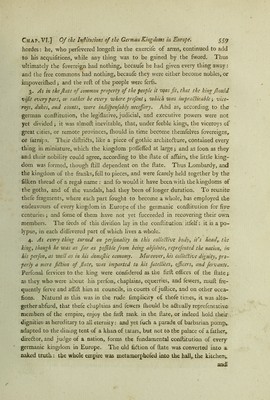
![Chap. VI.] Of the Inftitutions of the German Kingdoms in Europe. 55p hordes: he, who perfevered longeft in the exercife of arms, continued to add to his acquisitions, while any thing was to be gained by the fword. Thus ultimately the fovereign had nothing, becaufe he had given every thing away: and the free commons had nothing, becaufe they were either become nobles, or impoverished ; and the reft of the people were ferfs. 3. As in the ft ate of common property of the people it was fit, that the hing fhould vifit every part, or rather be every where prefent; which zvas impracticable; vice- roys, dukes, and counts, were indifpenfably neceffary. And as, according to the german conftitution, the legislative, judicial, and executive powers were not yet divided; it was almoft inevitable, that, under feeble kings, the viceroys of great cities, or remote provinces, Should in time become themfelves fovereigns, or Satraps. Their diftriCts, like a piece of gothic architecture, contained every thing in miniature, which the kingdom poffeffed at large •, and as Soon as they and their nobility could agree, according to the ftate of affairs, the little king- dom was formed, though ftill dependent on the ftate. Thus Lombardy, and the kingdom of the franks,fell to pieces, and were fcarely held together by the Silken thread of a regal name : and. fo would it have been with the kingdoms of the goths, and of the vandals, had they been of longer duration. To reunite thefe fragments, where each part fought to become a whole, has employed the endeavours of every kingdom in Europe of the germanic conftitution for five- centuries ; and fome of them have not yet fucceeded in recovering their own members. The feeds of this divifion lay in the conftitution itfelf: it is a po- lypus, in each diffevered part of which lives a wbole^ 4. As every thing turne d on per finality in. this collective body, it’s headr the king, though he was as far as poftible from being abfilute, reprefinted the nation, in his perfion, as well as in his domeftic economy. Moreover, his collective dignity, pro- perly a mere fiction of ftate, zvas imparted to his fatellites, officers, and fervants. Perfonal fervices to the king were considered as the firft offices of the ftate j as they who were about his perfon, chaplains, equerries, and fewers, muft fre- quently ferve and affift him at councils, in courts of juftice, and on other occa- sions. Natural as this was in the rude fimplicity of thofe times, it was alto- gether abfurd, that thefe chaplains and fewers Should be actually reprefentative: members of the empire, enjoy the firft rank in the ftate, or indeed hold their dignities as hereditary to all eternity: and yet fuch a parade of barbarian pomp,, adapted to the dining tent of a khan of tatars, but not to the palace of a father,, director, and judge of a nation, forms the fundamental constitution of every- germanic kingdom in Europe. The old fiction of ftate was converted into a. naked truth: the whole empire was metamorphofed into the hall, the kitchen* and!](https://iiif.wellcomecollection.org/image/b22010282_0581.jp2/full/800%2C/0/default.jpg)