A treatise on hygiene and public health, with special reference to the tropics / by Birendra Nath Ghosh and Jahar Lal Das.
- Ghosh, Birendra Nath, 1882-1957.
- Date:
- 1912
Licence: In copyright
Credit: A treatise on hygiene and public health, with special reference to the tropics / by Birendra Nath Ghosh and Jahar Lal Das. Source: Wellcome Collection.
Provider: This material has been provided by London School of Hygiene & Tropical Medicine Library & Archives Service. The original may be consulted at London School of Hygiene & Tropical Medicine Library & Archives Service.
132/406 (page 110)
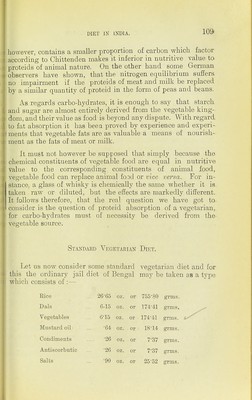
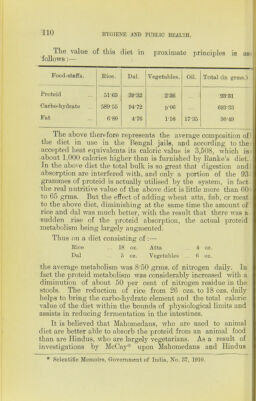
![The value of this diet in proximate principles is as follows:— Pood-staffs. Rice. Dal. Vegetables. Oil. Total (in grins.) Proteid 5163 3932 236 9331 Carbo-hydrate 589 55 94-72 906 693-33 Fat 6-80 4-76 1-58 1735 30-49 The above therefore represents the average composition of the diet in use in the Bengal jails, and according to the | accepted heat equivalents its caloric value is 3,508, which is -about 1,000 calories higher than is furnished by Ranke's diet. In the above diet the total bulk is so great thai digestion and | absorption are interfered with, and only a portion of the 93 \ grammes of proteid is actually utilised by the system, in fact the real nutritive value of the above diet is little more than 60 to 65 grms. But the effect of adding wheat atta, fish, or meat to the above diet, diminishing at the same time the amount of rice and dal was much better, with the result that there was a sudden rise of the proteid absorption, the actual proteid metabolism being largely augmented. Thus on a diet consisting of :— Rice ... 18 oz. Atta ... 4 oz. Dal ... 5 oz. Vegetables ... 6 oz. the average metabolism was 8'50 grms. of nitrogen daily. In fact the proteid metabolism was considerably increased with a diminution of about 50 per cent of nitrogen residue in the stools. The reduction of rice from 26 ozs. to ]8 ozs. daily helps to bring the carbo-hydrate element and the total caloric value of the diet within the bounds of physiological limits and assists in reducing fermentation in the intestines. It is believed that Mahomedans, who are used to animal diet are better able to absorb the proteid from an animal food than are Hindus, who are largely vegetarians. As a result of investigations by McCay* upon Mahomedans and Hindus Scientific Memoirs, Government of India, No. 37, 1910.](https://iiif.wellcomecollection.org/image/b21359969_0132.jp2/full/800%2C/0/default.jpg)