A catalogue of the Arabic manuscripts in the library of the India Office / by Otto Loth.
- Great Britain. India Office. Library
- Date:
- 1975
Licence: Open Government Licence
Credit: A catalogue of the Arabic manuscripts in the library of the India Office / by Otto Loth. Source: Wellcome Collection.
103/344 (page 89)
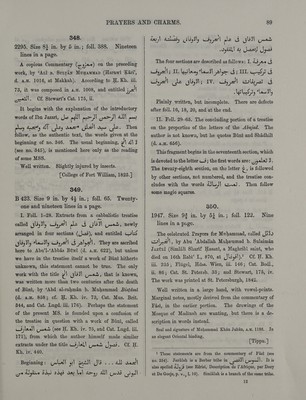
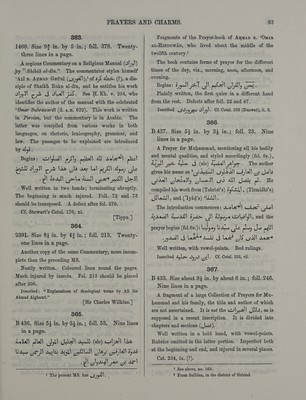
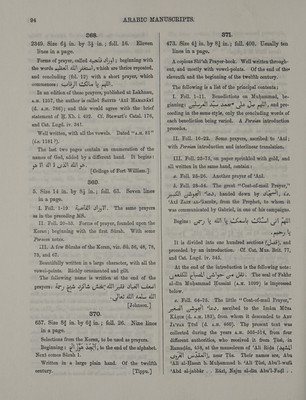
![348. 2295. Size 81 in. by 5 in.; foll. 388. lines in a page. Nineteen A copious Commentary (< yy) on the preceding work, by ‘Ari s. Surra4n Musammap (Harawi Kari’, d. a.H. 1016, at Makkah). According to H. Kh. iii. 78, it was composed in a.H. 1008, and entitled pel well. Cf. Stewart’s Cat. 175, ii. It begins with the explanation of the introductory words of Ibn Jazari, bo eel esol r= Fall eo os dass aT ides Ms hell aw ges Then follow, as the authentic text, the words given at the beginning of no. 346. The usual beginning, PA ‘ly (see no. 345), is mentioned here only as the reading of some MSS. Well written. Slightly injured by insects. [College of Fort William, 1825. ] 349. B 4238. Size 9 in. by 43 in.; foll. 65. Twenty- one and nineteen lines in a page. I. Foll. 1-28. Extracts from a cabbalistic treatise called 335), Lis sl me & Gull Guat, newly arranged in four sections (25), and entitled WLS geal, sleSl, Ki, I & lyst. They are ascribed here to Abu’l-‘Abbas Btwi (d. a.w. 622), but unless we have in the treatise itself a work of Bani hitherto The only work with the title ¢\ SUN Cues, that is known, was written more than two centuries after the death of Bini, by ‘Abd al-rahman b. Muhammad Bistdmi (d. aH. 858; cf. H. Kh. iv. 73, Cat. Mus. Brit. 344, and Cat. Lugd. iii. 176). Perhaps the statement of the present MS. is founded upon a confusion of unknown, this statement cannot be true. the treatise in question with a work of Bini, called ai jel) Ue (see H. Kh. iv. 75, and Cat. Lugd. iii. 171), from which the author himself made similar extracts under the title 3 lel! (pats Md Jyas. Of. H. Kh. iv. 440. Beginning: (pwlaell | renal ellis teal) Sie crt Egire FAG 5d de bel dm, alll Quad col 89 dey) chad, Gly, Ciysel ple B GUI Guat oyHihl 4) Jas! Spas The four sections are described as follows: I. hb ne eg CSyys!l; IL. leileny Lad lye $; IT S55 Gyo de GUM; IV. Gye OW Plainly written, but incomplete. There are defects after foll. 16, 18, 20, and at the end. II. Foll. 29--65. The concluding portion of a treatise on the properties of the letters of the Abwad. The author is not known, but he quotes Bini and Shadhili (d. a.H. 656). This fragment begins in the seventeenth section, which is devoted to the letter 4; the first words are: hd y. The twenty-eighth section, on the letter > is followed by other sections, not numbered, and the treatise con- cludes with the words dJle/] wi. Then follow some magic squares. 350. 1947. Size 93 in. by 5} in.; foll. 122. lines in a page. Nine The celebrated Prayers for Muhammad, called BR) ols, by Abu ‘Abdallah Muhammad b. Sulaiman Jaztxri (Simlali Sharif Hasani, a Maghribi saint, who died on 16th Rabi‘ I., 870, at (Jl¢,3\).’ Cf. H. Kh. iti. 235; Fliigel, Hdss. Wien, ii. 146; Cat. Bodl., ii. 86; Cat. St. Petersb. 33; and Stewart, 175, iv. The work was printed at St. Petersburgh, 1842. Well written in a large hand, with vowel-points. Marginal notes, mostly derived from the commentary of The drawings of the Mosque of Madinah are wanting, but there is a de- Fasi, in the earlier portion. scription in words instead. Seal and signature of Muhammad Khan Jahan, a.w, 1186. In an elegant Oriental binding, P [Tippu. ] 1 These statements are from the commentary of Fast (see no. 354), Jazilah is a Berber tribe in ail mgd It is also spelled ra yj (see Edrisi, Description de |’ Afrique, par Dozy et De Goeje, p. v,, 1.10). Simlalah is a branch of the same tribe. 12](https://iiif.wellcomecollection.org/image/b32232214_0103.jp2/full/800%2C/0/default.jpg)