A catalogue of the Arabic manuscripts in the library of the India Office / by Otto Loth.
- Great Britain. India Office. Library
- Date:
- 1975
Licence: Open Government Licence
Credit: A catalogue of the Arabic manuscripts in the library of the India Office / by Otto Loth. Source: Wellcome Collection.
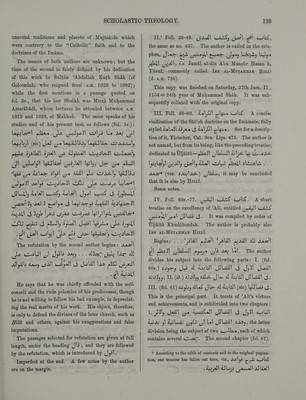
138/344 (page 124)
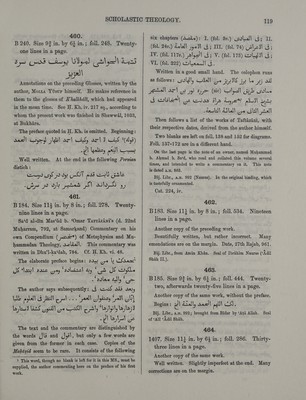
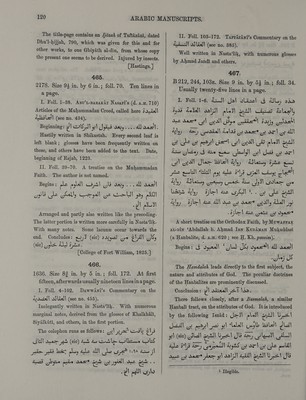
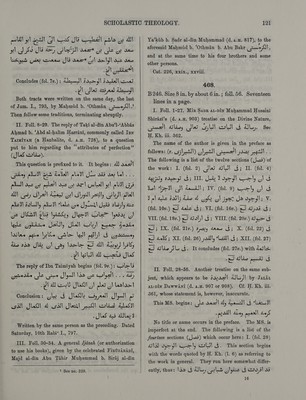
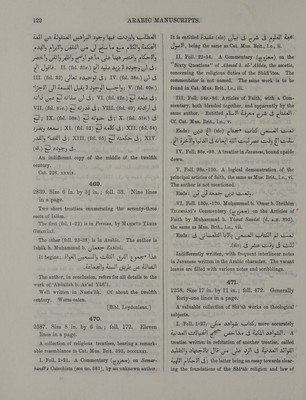
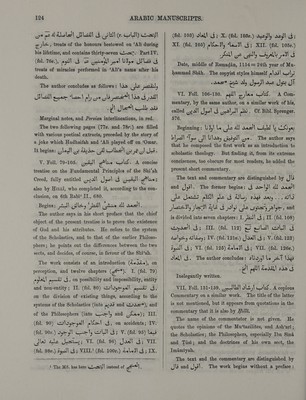
![wrt eed hole! Usladl & Sul (OW) esl red gl , treats of the honours bestowed on ‘Ali during his lifetime, and contains thirty-seven .o<7. Part IV. (fol. 76v.), esl bidde cpawegll jal ye las & treats of miracles performed in ‘Ali’s name after his death. The author concludes as follows: \d» fe pail, Silda eet thant aly aye yb pare Ido G jal Marginal notes, and Persian interlineations, in red. The two following pages (77v. and 78r.) are filled with various poetical extracts, preceded by the story of a joke which Hudhaifah and ‘Ali played off on ‘Omar. It begins: jlo) op dy d= e. wibe't erty! dS. V. Foll. 79-105. wai Gln wlLS. A concise treatise on the Fundamental Principles of the Shi‘ah Creed, fully entitled os) Jeol is eid ‘cdikead) also by Hrt1i, who completed it, according to the con- clusion, on 6th Rabi‘ IT., 680. Begins; piel ilk, * ail | cate & welt. The author says in his short preface that the chief object of the present treatise is to prove the existence of God and his attributes. He refers to the system of the Scholastics, and to that of the earlier Philoso- phers; he points out the differences between the two sects, and decides, of course, in favour of the Shi‘ah. The work consists of an introduction (de div), on perception, and twelve chapters (*). I. (fol. 79) ° hel | ‘cme 3, on possibility and impossibility, entity and non-entity ; II. (fol. 80) lm gall ‘commend 3, on the division of existing things, according to the systems of the Scholastics (into mos and o.ie), and of the Philosophers (into Wel, and . se); III. (fol. 90) log> all eat 3, on accidents; IV. (fol. 90v.) dh) Cael, coll 8; V. (fol. 95) Las dlei the Saetuas; VI. (fol. 96) Joel 4; VIL (fol. 980.) gaa) 8; VIII! (fol. 100v.) doledl § ; IX. 1 The MS. has here Ws<W\ instead of Pa ; (fol. 103) ole! $; X. (fol. 1030.) wredly ves! G; XI. (fol. 105) ood, Lo 2; XII. (fol. 1050.) Al Be uel seal oI 8 Date, middle of Ramadan, 1154= 24th year of Mu- hammad Shah. The copyist styles himself elas HI roast ae aly Sood oe Su JT VI. Foll. 106-180. pg! cylee CLS. A Com- mentary, by the same author, on a similar work of his, called syd!) Jyol 8 ant t! = . Of. Bibl. Sprenger. 576. Beginning : \j¥,\ le er a) ons!) eb! L AS ge) Lah! “Tyas S Glory iadel] wpe. The author says that he composed the first work as an introduction to scholastic theology. But finding it, from its extreme conciseness, too obscure for most readers, he added the present short commentary. The text and commentary are distinguished by J\s and (J43\. The former begins: 8 a>',\ al! ves) de Sats oll ple $ Als, dg oe... ails is divided into seven chapters; I. past 3; IL. (fol. 108) yrs!) $; IIL (fol. 112) 25 pila old huolycdy Ailing; IV. (fol. 1210.) Joell 8; V. (fol. 128) Syecl) 3; VI. (fol. 125) dvled| 8; VIL. (fol. 1260.) diel! (8. The author concludes: sUu 55) be pel Vinge 2 eel dodal! sda 8 Inelegantly written. VIL. Foll. 131-159. veyed lb! ols | WkS. A copious Commentary on a similar work. The title of the latter is not mentioned, but it appears from quotations in the commentary that it is also by Hi/li. He quotes the opinions of the Mu‘tazilites, and Ash‘ari; the Scholastics; the Philosophers, especially Ibn Sina and Tisi; and the doctrines of his own sect, the Imamiyah. The text and the commentary are distinguished by J\é and 431. The work begins without a preface : The name of the commentator is not given.](https://iiif.wellcomecollection.org/image/b32232214_0138.jp2/full/800%2C/0/default.jpg)