Annual report of the Medical Officer of Health of the Borough of Hammersmith for the year 1922.
- Hammersmith (London, England). Metropolitan Borough.
- Date:
- [1923]
Licence: Attribution-NonCommercial 4.0 International (CC BY-NC 4.0)
Credit: Annual report of the Medical Officer of Health of the Borough of Hammersmith for the year 1922. Source: Wellcome Collection.
39/82 (page 41)
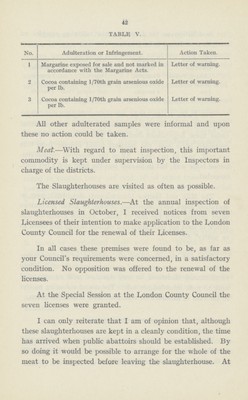
![41 In addition to the foregoing, the following samples on analysis were found to be genuine:— Chocolates 6 samples. Malt Vinegar 7 samples. Cornflour 1 sample. Oatmeal 1 sample. Custard Powder 3 samples. Pepper 1 sample. Grape-Nuts 5 samples. Salt 1 sample. Self-raising Flour 1 sample. Jam 4 samples. The Public Health (Milk and Cream) Regulations. —Eight samples of cream and four of preserved cream were examined under these Regulations during the year. Six of the former contained boric acid, the amounts found ranging from 0.28 per cent, to 0.6] pet cent. All of the preserved creams contained boric acid, but in no case was the limit of 0.4 per cent, exceeded. The Milk and Dairies (Amendment) Act, 1922, now in operation gives very important powers to Local Authorities when dealing with the sale of milk. Various grades of this article of food are recognised and explicit details laid down as to purity, &c. This Act also prohibits the addition of any colouring matter or water, or any dried or condensed milk or any fluid reconstituted therefrom, or any skimmed milk or separated milk to milk intended for sale. The use of colouring matter in the- case of skimmed or separated milk is also forbidden. The following Table shews action taken on adulterated samples (other than milk and cream), and other infringements of the Sale of Food and Drugs Acts.](https://iiif.wellcomecollection.org/image/B1811832X_0039.jp2/full/800%2C/0/default.jpg)