A practical treatise on artificial crown- and bridge-work / By George Evans. With 500 illustrations.
- George Evans
- Date:
- 1888
Licence: Public Domain Mark
Credit: A practical treatise on artificial crown- and bridge-work / By George Evans. With 500 illustrations. Source: Wellcome Collection.
Provider: This material has been provided by the Augustus C. Long Health Sciences Library at Columbia University and Columbia University Libraries/Information Services, through the Medical Heritage Library. The original may be consulted at the the Augustus C. Long Health Sciences Library at Columbia University and Columbia University.
40/268 page 40
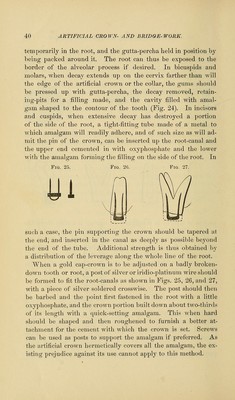
![temporarily in the root, and the gutta-percha held in position bj being packed around it. The root can thus be exposed to the border of the alveolar process if desired. In bicuspids and molars, when decay extends up on the cervix farther than will the edge of the artificial crown or the collar, the gums should be pressed up with gutta-percha, the decay removed, retain- ing-pits for a filling made, and the cavity filled with amal- gam shaped to the contour of the tooth (Fig. 24). In incisors and cuspids, when extensive decay has destroyed a portion of the side of the root, a tight-fitting tube made of a metal to which amalgam will readily adhere, and of such size as will ad- mit the pin of the crown, can be inserted up the root-canal and the upper end cemented in with oxyphosphate and the lower with the amalgam forming the filling on the side of the root. In Fig. 25. Fig. 26. Fig. 27. Ui such a case, the pin supporting the crown should be tapered at the end, and inserted in the canal as deeply as possible beyond the end of the tube. Additional strength is thus obtained ])y a distribution of the leverage along the whole line of the root. When a gold cap-crown is to be adjusted on a badly broken- down tooth or root, a post of silver or iridio-platinum wire should be formed to fit the root-canals as shown in Figs, 25, 26, and 27, with a piece of silver soldered crosswise. The post should then be barbed and the point first fastened in the root with a little oxyphosphate, and the crown portion built down about two-thirds of its length with a quick-setting amalgam. This when hard should be shaped and then roughened to furnish a better at- tachment for the cement with which the cro^vn is set. Screws can be used as posts to support the amalgam if preferred. As the artificial crown hermetically covers all the amalgam, the ex- isting prejudice against its use cannot apply to this method.](https://iiif.wellcomecollection.org/image/b21223105_0040.jp2/full/800%2C/0/default.jpg)