A practical treatise on artificial crown- and bridge-work / By George Evans. With 500 illustrations.
- George Evans
- Date:
- 1888
Licence: Public Domain Mark
Credit: A practical treatise on artificial crown- and bridge-work / By George Evans. With 500 illustrations. Source: Wellcome Collection.
Provider: This material has been provided by the Augustus C. Long Health Sciences Library at Columbia University and Columbia University Libraries/Information Services, through the Medical Heritage Library. The original may be consulted at the the Augustus C. Long Health Sciences Library at Columbia University and Columbia University.
85/268 page 85
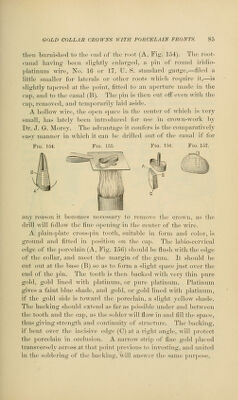
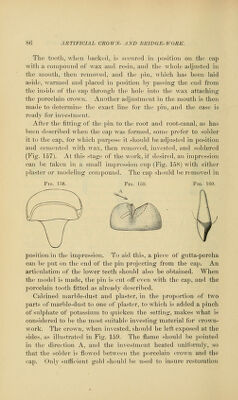
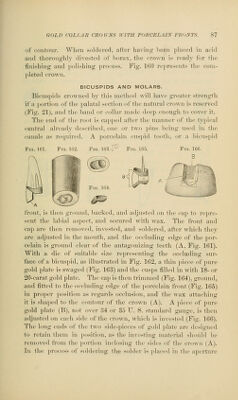
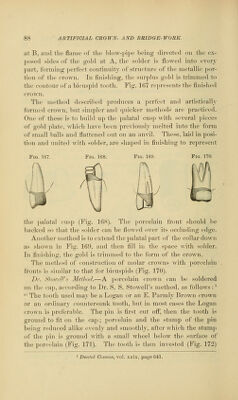
![tlic'ii bnrnisliod to the end of the root (A, Fig. 154). Tlie I'oot- canal liaving l:)een sliglitlj enlarged, a pin of round iridio- platinum wdre, ISTo. 16 or 17, U. S. standard gaitge,—tiled a little smaller for laterals or other roots wliieli require it,—is slightly tapered at the point, titted to an aperture made in the cap, and to the canal (B). The pin is then cut off even with the cap, removed, and tem])orarily laid aside. A liollow Avire, tlic o]ien space in the center of which is very small, has lately been intro(hiced for use in crown-work by Dr. J. G. Morey. The advantage it confers is the comparatively easv manner in which it can l)e drilled out of tlie canal if for Fig. 154. Fig. 155. Fig. 156. any reason it becomes necessary to remove the crown, as the drill will follow the tine opening in the center of the wire. A plain-plate cross-pin tooth, suitable in form and color, is groinid and fitted in position on the ca]). The lal)io-cervical edge of the jiorcelain (A, Fig. 156) should l)e flush with the vilga of the collar, and meet the margin of the gum. It should be cut out at the base (B) so as to form a slight s]>ace Just ovei- the end of the ])in. The tooth is then l)acke(l witli very thin ])ure gold, gold lined A\ith platinum, or pure ])latinnm. Platinum gives a faint l»lue sluule, and gold, or gold lined with ])latinum, if the gold side is toward the porcelain, a slight yellow shade. The backing should extend as far as ])<)ssible under and between the tooth and the cap, as the solder will flow in aiul fill the space, thus giving strength and continuity of structure. The backing, if bent over the incisive edge (C) at a right angle, will ]>rotect the porcelain in occlusion. A nai-row strip of fine gold ]»laced transversely across at that point ]ire\iousto investing, and united in the soldering of the backing, will answer the same purpose.](https://iiif.wellcomecollection.org/image/b21223105_0085.jp2/full/800%2C/0/default.jpg)