Licence: Public Domain Mark
Credit: Annual sanitary report of the Province of Assam. Source: Wellcome Collection.
23/52 page 15
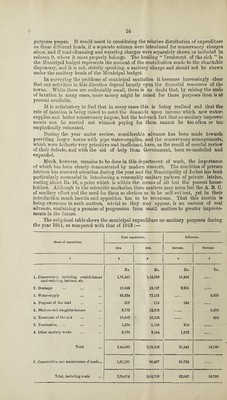
![,f Among the immigrant population, which forms the bulk of the labour foroe of the tea industr) of the proivince, different conditions prevail. The degree of infection of the population as a whole, and of the imliviluals in person, seems greater, and the prevalence of ancylostomiasis is a fertile source of economic inefficiency an 1 an important predisposing cause of mortality (from dysentery and diarrhoea) among the labour force in places where measures aimed at its extinction have been imperfectly carried out, or only recently introduced. “ The reasons for this greater intensity appear to be the aggregation of infected persons in coramu” nitiei which make no attempt at any system of disposal of night-soil, which is deposited indiscrimi nately within a radius of 10U yards of the lines in jungle, or among tea bushes. The abundant mois¬ ture and high temperature of the Assam hot weather provides ideal breeding conditions for the parasite, and the whole of the soil surrounding the lines becomes heavily charged with possibilities of infection. These possibilities become probabilities every time the bare-footed worker enters or passes through this highly infected area. Cons quen ly a measure of prophylaxis, which is extensively practised, aiming at anointing the feet and legs of the worker with an ointment of lysol or creoline before an 1 after working hours, has but a partial although valuable application. “ A Medical officer of the tea industry in the district of Nowgong gives an account of the current method of prophylaxis by vermifuge treatment, which, with minor modifications, is now universally practised throughout the tea industry. He states that by regular musters and the car ful administration of Thymol (in these days ‘ Beta-Napthol ”) you hardly ever seethe dropsical case, the disease being taken in time.-” Experience has shown that on tea estates where this routine has been carefully and thoroughly carried out for a period of years, the motality and inefficiency from ankylostomiasis has undoubtedly been very greatly reduced. The desirability of introducing some simple but efficient form of conservancy system to reduce inefficiency from ankylostomiasis, dysentery and diarrhoea and cholera has been emphasised time and again. When the economic importance of this necessary innovation has been sufficiently realised, it is probable that the energy and determination which has characterised the growth of the tea industry will be able to overcome the undoubted difficulties which prejudice and ignorance now place in the way. With regard to the species of parasite found and as to whether N. Americanus, A. Duodenale or A. Ceylanioum is the commoner variety, it is worthy of note that a cer¬ tain number of worms were furnished for examination to Major Clayton Lane by a Medical officer of the tea industry in Sibsagar, and of these 384 proved to be Necator Americanus and 3 were Agcliylos toma Duodenale. It is not, however, known whether the same proportions hold good elsewhere. SECTION VII. VACCINATION. [Published separately.'] SECTION VIII. SANITARY WORKS—MILITARY. [No remarks.] SECTION IX. 8ANITARY WORKS—CIVIL. 29. The number of Municipalities, Unions and Stations in the province remained the same as in the previous year, viz., 14 Municipalities, GeneraL 4 Unions and 1 Station. 30. The income of the above Municipalities and Unions and the Stations amounted •. . to Its. 8,50,613 during the year under report, as compared Municipal expenditure on sanitation. 6,60,390 in the previous year. The increase of Its. 1,90,223 is not due to increased rates of taxation, but to large grants-in-aid received from Government to finance the construction of water-works and other schemes. The expen¬ diture on sanitation amounted to Its. 3,70,076, as compared with Its. 3,04,769 of the previous year, showing an increase of Rs. 65,307. The percentage of the expen¬ diture incurred on sanitation proper, excluding that upon roads, was. 28'58 during the vear, as compared with 35*7 of the previous year. The Municipality of Karimganj spent 79-68 per cent, of its income on sanitation, three Municipalities spout between 50 and 60 per cent., one 40 per cent., six between 30 and 40 percent., two between 20 and 30 per cent, and six below 20 per cent, of their income on this purpose. The heading “ Conservancy,5’ including “ road-watering and cleansing,55 in form 3 of the statement in the annual reports on the working of municipalities in Assam does not sufficiently clearly show the amount which is expended on conservancy](https://iiif.wellcomecollection.org/image/b31495540_0023.jp2/full/800%2C/0/default.jpg)


 No text description is available for this image
 No text description is available for this image
 No text description is available for this image