A contemporary narrative of the proceedings against Dame Alice Kyteler, prosecuted for sorcery in 1324, by Richard de Ledrede, bishop of Ossory / edited by Thomas Wright.
- Date:
- 1843
Licence: Public Domain Mark
Credit: A contemporary narrative of the proceedings against Dame Alice Kyteler, prosecuted for sorcery in 1324, by Richard de Ledrede, bishop of Ossory / edited by Thomas Wright. Source: Wellcome Collection.
17/120 page 9
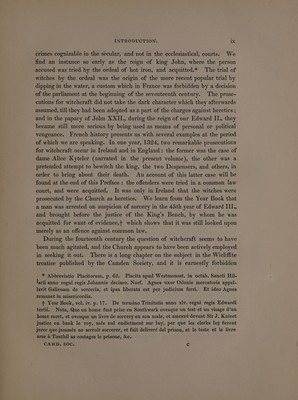
![erimes cognizable in the secular, and not in the ecclesiastical, courts. We find an instance so early as the reign of king John, where the person accused was tried by the ordeal of hot iron, and acquitted.* The trial of witches by the ordeal was the origin of the more recent popular trial by dipping in the water, a custom which in France was forbidden by a decision of the parliament at the beginning of the seventeenth century. The prose- cutions for witcheraft did not take the dark character which they afterwards assumed, till they had been adopted as a part of the charges against hereties ; and in the papacy of John XXII., during the reign of our Edward II., they became still more serious by being used as means of personal or political vengeance. French history presents us with several examples at the period of which we are speaking. In one year, 1324, two remarkable prosecutions for witcheraft occur in Ireland and in England: the former was the case of dame Alice Kyteler (narrated in the present volume), the other was a pretended attempt to bewitch the king, the two Despensers, and others, in order to bring about their death. An account of this latter case will be found at the end of this Preface: the offenders were tried in a common law court, and were acquitted. It was only in Ireland that the witches were prosecuted by the Church as heretics. We learn from the Year Book that a man was arrested on suspicion of sorcery in the 45th year of Edward III., and brought before the justice of the King's Bench, by whom he was acquitted for want of evidence,] which shows that it was still looked upon merely as an offence against common law. During the fourteenth century the question of witcheraft seems to have been much agitated, and the Church appears to have been actively employed in seeking it out. There is a long chapter on the subject in the Wiclifüite treatise published by the Camden Society, and it is earnestly forbidden * Abbreviatio Placitorum, p. 62. Placita apud Westmonast. in octab. Sancti Hil- larii anno regni regis Johannis decimo. Norf. Agnes uxor Odonis mercatoris appel- lavit Galienam de sorceria, et ipsa liberata est per judicium ferri. Et ideo Agnes remanet in misericordia. T Year Book, vol. iv. p. 17. De termino Trinitatis anno xlv. regni regis Edwardi tertii. Nota, Que un home fust prise en Southwark ovesque un test et un visage d'un home mort, et ovesque un livre de sorcery en son male, et amesné devant Sir J. Knivet justice en bank le roy, més nul endictment sur luy, per que les clerks luy fierent jurer que jammés ne serroit sorcerer, et fuit deliveré del prison, et le teste et le livre arse à Touthil as costages le prisone, &c. CAMD. SOC. c](https://iiif.wellcomecollection.org/image/b33096831_0017.jp2/full/800%2C/0/default.jpg)