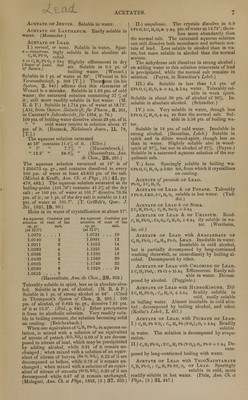
First outlines of a dictionary of solubilities of chemical substances / by Frank H. Storer.
- Francis Humphreys Storer
- Date:
- 1864
Licence: Public Domain Mark
Credit: First outlines of a dictionary of solubilities of chemical substances / by Frank H. Storer. Source: Wellcome Collection.
Provider: This material has been provided by the National Library of Medicine (U.S.), through the Medical Heritage Library. The original may be consulted at the National Library of Medicine (U.S.)
22/742
![etk I V 0 TL Deli- Planta Soluble in water, and Very soluble in wa- Soluble in water. (Vauque- Acetate of Ethylamin. Very deliquescent. (A. Wurtz, Ann. Ch. et. Phys., (3.) 30. 490.) Acetate of Ethylene. o I) normal. Soluble in 7 pts. of water at 22 . C1,H10O8 = CsHB(C4H4)O8 Soluble in all propor- (Binacetate of Glycol. Iso- tjons m alcohol, and meric with the compound of , ~ , addition Aldehyde with anhydrous Acet- ettier. Un tne auuluou icAcid.) of chloride of calcium it separates out from the aqueous solution. (A. Wurtz.) II.) mono. Miscible with water, and alcohol. C8 H806 = C4H4, 04H40„ (Atkinson.) (Monacetate of Glycol.) III.) basic. CigHu010 Acetate of Ethyl chlore — quintichlore. Vid. Acetate of ChlorEthyl. Acetate of Ethyl sexchlore. Vid. ChlorAcetate of perChlorEthyl. Acetate of Ethyl septichlore'. Vid. ot'ChlorAcetate of perChlorEthyl. Acetate of Ethyl perchlore. Vid. terChlorAcetate of perChlorEthyl. Acetate of EthylMethylConiin quescent. Readily soluble in water, (v. & Kekule, Ann. Ch. u. Pharm., 89. 139. Acetate of EthylNicotin. Very easily soluble in water. (v. Planta & Kekule', Ann. Ch. u. Pharm., 87. 6.) Acetate of EthylStrychnine. Soluble in water. Acetate of Fumarin. alcohol. (Hannon.) Acetate of Fcrfurin ter. (Fownes.) Acetate of Glatjcin. Acetate of Glucina. I.) normal. Very soluble in water C12H9G12',012 lin.) II.) terbusic. Very deliquescent and soluble in water. The basic acetates of glucina which contain - more than six equivalents of base to «se of acid are insoluble in water, but those containing less than six equivalents of base may be obtained in solution. (Ordway, Am. J. Sci. (2.) 26. 207.) Acetate of Glyceryl. I) normal. Insoluble in water and not mis- C18ll140„ = C6IIB03,3 C4Hs08, cible therewith. Read- orCr,n,,(C,,Hr/)012 ily soluble in spirit. (TnsMeun.) Soluble in ether. Ea- sily soluble in baryta-water. (Bcrthelot, Ann. Ch. et 'Phys., (3.) 41. 277.) II.) monobasic. With I vol. water it forms a C,4]l,,O10=C„H,O„lIO)2C4H3Os limpid mixture; {DiAcetin. Acelidin.) 2 more vols, of water cause an opalescence ; 5 vols, water render the liquor very opaline. With 200 vols, water it forms a transparent emulsion or solution. It is miscible with ether and dissolves in benzine; but is nearly or quite insoluble in bisulphide of carbon. (Berthelot, loc. cit.) III.) biltasic. Mixes with half its bulk of wa- C,„ H10 08 = c6 U6 03,2110, C4 U303 ter, forming a clear (MonoAcetin.) liquor which be- comes turbid when two additional volumes of wa- ter are added; it remains turbid also when a large excess of water is added to it. Miscible with ether. (Berthelot, loc. cit.) Acetate of Glycocoll. Soluble in water ; C4II5 N04,04 U4 04 + Act less easily soluble in alco- hol, (llorsford, Am. ./. Sci, (2.) 4. 63.) Acetate of Glycol. Vid. Acetate of Ethylene. Acetate of Gold (Au02). Known only in solution. This solution slowly decomposes when left to itself, or immediately on being boiled. (H.Rose, Pogg. Ann., 83. 149.) Acetate of Harmalin. Acetate of Harmin. Acetate of HydrargEthyl. Vid. Acetate of MercurEthyl. Acetate of protoxide of Iron. Easily ox- C4H3Fe04 + 3Aq idizes in the air. Very solu- ble in water. Acetate of sesquioxide of Iron. I.) mono. Very soluble in water. (Bette.) Sol- Fe2 03, C4 H3 03 + 4 Aq uble in 3 pts. of water. Sol- uble in 6 pts. of highly recti- fied alcohol. Soluble in 4 pts. of ordinary alcohol. (Walz, in Wittstcin's Handw.) The aqueous so- lution is decomposed by boiling. (Duflos.) II.) 6?'. Soluble in water and in alcohol. Fe203,2C4H303 + Aq (Oudemans.) The aqueous solution undergoes partial decomposition in the cold and is totally decom- posed on boiling. (W. Crum, Ann. Ch. u. Pharm., 89. 173.) III.) sesqui. Slowly but completely soluble 2Fe2O3,3C4H3O3-f-10Aq in 3 pts. of cold water. This solution has a great tendency to become gelatinous. Incompletely soluble in absolute alcohol or in highly rectified spirit; but is soluble for the most part in 8 pts. of ordinary alcohol. Behaves like the teracetate as regards ether, chloroform, and acetate of ethyl. (Walz, in Wittstein's Handw.) IV.) ter, or normal. When exposed to the air it C,2 H9 Fe,' 012 + 4 Aq effloresces, losing 2 equivs. of HO. The 2 hydrated salt thus formed is soluble in almost all proportions in water, in 4 pts. of absolute alcohol, and in 3 pts. of highly rectified spirit. Insoluble in ether or chloroform. Very sparingly soluble in acetate of ethyl. (Walz, in Wittstein's Handw.) Soluble in a moderate amount of water, but is precipitated from this solution when the latter is diluted or boiled. (Barker.) The aqueous solution is liable to be decomposed to a slight extent both when di- lute or concentrated. This decomposition is some- what greater at the temperature of boiling than in the cold. (Crum, Ann. Ch. it. Pharm., 89. 173.) Miscible with alcohol. Soluble in acetic ether. When a solution of acetate of peroxide of iron is maintained at a temperature near 100° during several hours, the properties of the salt are essentially changed. The addition of a trace of sulphuric acid or of an alkaline salt occasioning the precipitation of an oxide of iron which is in- soluble in cold acids. [See under sesquioxide of iron hydrated (Fe20..,,3H0).] (Pean St. Gilles.) Hence, if a solution of sesquioxide of iron, contain- ing but little free acid, be treated with an excess of acetate of soda, and then boiled, all the iron will be precipitated. (Fresenius, Quant., p. 141.) V.) bibasic, or di Soluble in water; if this 2Fe203,C4H303 solution be diluted and boiled, a still more basic salt will be precipitated. (Janssen.) VI.) poll/basic. Basic acetates of iron which contain six equivalents or less of base to am//, equivalent of acid may be obtained dissolved in water, but those which contain a larger proportion of base than this, are insoluble. (Ordway. Am. J Sci., (2.) 26. 202.) Insoluble in acetic acid. (Duflos.)](https://iiif.wellcomecollection.org/image/b21157091_0022.jp2/full/800%2C/0/default.jpg)