First outlines of a dictionary of solubilities of chemical substances / by Frank H. Storer.
- Francis Humphreys Storer
- Date:
- 1864
Licence: Public Domain Mark
Credit: First outlines of a dictionary of solubilities of chemical substances / by Frank H. Storer. Source: Wellcome Collection.
Provider: This material has been provided by the National Library of Medicine (U.S.), through the Medical Heritage Library. The original may be consulted at the National Library of Medicine (U.S.)
32/742
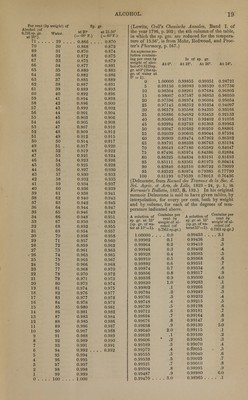
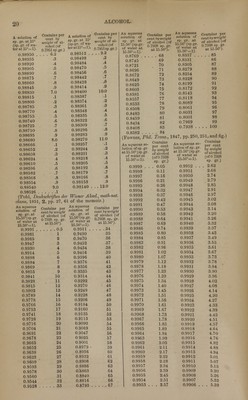
![acid. (Melsens, Ann. Ch. et Phys., (3.) 33. pp. 179, 180.) Chloride of mercury (corrosive subli- mate) precipitates albumen from its solution in many salts, as phosphate, sulphate, nitrate, or bo- rate of soda, nitrate or. sulphate of potash, and the like. These precipitates are often soluble in an excess of the compound of albumen and the salt; they are also soluble in phosphoric acid, in ammonia, and in potash ; an excess of acetic acid, however, always produces a permanent precipitate when added to these solutions. (Melsens, loc. cit., p. 180.) Alcohol, ether, oil of turpentine, and creosote act sensibly in the same manner upon so- lutions of the compounds of albumen with salts as upon those of normal albumen. In general, acids produce precipitates more readily in dilute solutions of the compounds of albumen with salts than in equally dilute solutions of pure albumen. (Melsens, loc. cit., p. 181.) Soluble in cold concentrated chlorhydric acid, from which solution it is precipitated by alkalies. When this solution is mixed with a concentrated solution of potash or soda, it forms a firm jelly, which when decomposed by an acid furnishes al- bumen which is more difficultly soluble in chlorhy- dric acid than it was originally. (Caventou, Ann. Ch. et Phys., (3.) 8. pp. 326, 327.) II.) Insoluble Modification. Insoluble in cold wa- ter, but is partially dissolved with alteration when boiled for a long time with water. If it is maintained at 150° with a small quantity of water in a sealed tube, it gradually dissolves, and is no longer capable of coagulating. (L. Gmelin.) Insoluble in alcohol or ether. Soluble in warm acetic, tartaric, and (c) phosphoric acids. Soluble in concentrated, but insoluble, even in exceedingly dilute chlorhydric acid alone, but dis- solves therein when in presence of a peculiar sub- stance [pepsin] which occurs in the stomachs of living animals. (Bouchardat & Sandras, Ann. Ch.etP/tys., (3.) 5.484.) III.) Vegetable Albumen. Soluble in water, and is coagulated by heating. Soluble in acetic acid. Insoluble in boiling alcohol, or ether. (Dumas & Cahours, Ann. Ch. et Phys., (3.) 6. pp. 409, 389.) Albumen with X. Vid. Albuminate of X. Also under Albumen (Soluble Modification). Albuminate of Baryta. Insoluble in wa- C144 H113 Ba NIS S2 Ou + 2 Aq (?) ter, alcohol, or ether. Albuminate of Baryta & of Copper. Albuminate of Copper. Insoluble in water C144Hu0 Cxx^wS2Ou+ 2 Aq? or alcohol. Albuminate of Copper & of Lime. Albuminate of Copper & of Magnesia. In- soluble in water. Albuminate of Copper & of Potash. Is swollen up, and eventually dissolved by water. Albuminate of Lead. Insoluble in water. Soluble in a solution of acetate of lead. Decom- posed by all acids, even by carbonic acid. (A. Wurtz, Ann. Ch. et Phys., (3.) 12. 218.) Albuminate of Lime. Insoluble in water. Albuminate of Mercury, or rather of Chlo- ride of Mercury. [See also Art. Albumen (No- I.).] Insoluble in water. Before having been dried, water dissolves traces of it. It is dissolved in considerable quantity by aqueous solutions of the alkaline chlorides, bro- mides, and iodides ; also by cold phosphoric, sul- phurous, arsenic, acetic, oxalic, tartaric, malic, and racemic acids, but to no appreciable extent by sul- phuric, nitric, chlorhydric, or tannic acids. It is also easily soluble in aqueous solutions of caustic potash, soda, lime, and ammonia, but with subse- quent decomposition. (Wittstein's Handw.) 1 pt. of the freshly-precipitated compound is soluble in 4.1 pts. of chloride of sodium, in saturated aqueous solution. (Voit, Ann. Ch. u. Plturm., 104. 365. Soluble in solutions of iodide of po- tassium, either neutral or alkaline, or in presence of dilute acids. (Melsens, Ann. Ch. et Phys., (3.) 26. 221.) Albuminate of Potash. a.) Soluble in boiling water, and in alcohol. b.) c1MII1i0K2N18S2OM + 2Aq Insoluble in boil- ing water, alcohol, or ether. Albuminate of Silver. CH4nmAgN18S2044 + 2Aq(') Albuminate of Soda. a.) acid. More soluble in water than pure al- Ci« Hm Na N18 S2 0M + 2 Aq bumen. b.) normal. Almost insoluble in cold water. C144 Hu0 Naj N18 S2 0M + 2 Aq Albuminate of Strontia. Insoluble in water. Albuminate of Zinc. Insoluble in water, C144 Hn0 Zn2 N18 S2 0M + 2 Aq (?) and alcohol. Albuminin (of Courbe). Insoluble in water, {Oonin.) alcohol, ether, or acetic acid. Soluble in chlorhydric acid, and in aqueous al- kaline solutions. (Courbe.) Alkarsin. Vid. Oxide of Cacodyl. Alcohol. Absorbs water from the air. Mis- (Hydmte of Ethyl. Hy- cible in all proportions with tXo£Xt.lT *—iheat hrs •*** i iioj contraction of volume also occurs, and this augments till the mixture contains 116 pts. of water to 100 pts. of alcohol. (Kudberg.) Miscible in all proportions with wood-spirit, chloroform, ether, acetic acid, formic acid, most of the essential oils, methylal, sulphide, bisulphide, and sulpho- carbonate of methyl, &c.; absolute alcohol is also miscible in all proportions with naphtha, and benzin. 1 vol. of ordinary alcohol dissolves in about 3 vols of nitrotoluene when this has been warmed by the hand. (C. M. Warren.) It can be said, in general terms, that alcohol is a good solvent for substances which contain much hydrogen, as resins, ethers, essential oils, including those which are oxygenated, fats, the alkaloids, coloring matters, and many organic acids It does not dissolve the sulphates or carbonates of the metallic oxides. It also dissolves sugars and Those gases which are abundantly absorbed by water likewise dissolve in considerable quantity in alcohol; and hose which are sparingly absorbed by water are a so taken up in small quantity only by alcohol; but alcohol generally1 takes uTa greater quantity of a gas, bulk for bulk t ,11 water. Among the elementary substances ah, hoi dissolves only a few, such as phosphorus J sulphur^, bromine, iodine, &c, all of the n™ metallic class. With respect to inorganic stances, it may be stated as a law, that all r„„| pounds soluble in alcohol are also soluble in watS but that there are some compounds soluble in ^ ter which are not soluble in alcohol; moreover that compounds which are soluble in'both liquid!' dissolve more abundantly in water than in hydrai \A alcohol, and in the latter more than in absolute alcohol. Such is the case with metallic sulphides](https://iiif.wellcomecollection.org/image/b21157091_0032.jp2/full/800%2C/0/default.jpg)