The expression of the emotions in man and animals / by Charles Darwin ; edited by Francis Darwin.
- Charles Darwin
- Date:
- 1904
Licence: Public Domain Mark
Credit: The expression of the emotions in man and animals / by Charles Darwin ; edited by Francis Darwin. Source: Wellcome Collection.
17/458 page 9
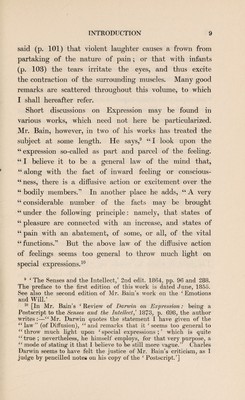
![said (p. 101) that violent laughter causes a frown from partaking of the nature of pain; or that with infants (p. 103) the tears irritate the eyes, and thus excite the contraction of the surrounding muscles. Many good remarks are scattered throughout this volume, to which I shall hereafter refer. Short discussions on Expression may be found in various works, which need not here be particularized. Mr. Bain, however, in two of his works has treated the subject at some length. He says,9 “I look upon the 44 expression so-called as part and parcel of the feeling. 44 I believe it to be a general law of the mind that, 44 along with the fact of inward feeling or conscious¬ ness, there is a diffusive action or excitement over the 44 bodily members.' In another place he adds, 44 A very 44 considerable number of the facts may be brought 44 under the following principle: namely, that states of 44 pleasure are connected with an increase, and states of 44 pain with an abatement, of some, or all, of the vital 44 functions. But the above law of the diffusive action of feelings seems too general to throw much light on special expressions.10 9 4 The Senses and the Intellect/ 2nd edit. 1864, pp. 96 and 288. The preface to the first edition of this work is dated June, 1855. See also the second edition of Mr. Bain’s work on the 4 Emotions and Will.’ 10 [In Mr. Bain’s 4 Review of Darwin on Expression: being a Postscript to the Senses and the Intellect,’’ 1873, p. 698, the author writes :—44 Mr. Darwin quotes the statement I have given of the 44 law ” (of Diffusion), 44 and remarks that it 4 seems too general to 44 throw much light upon 4 special expressions;’ which is quite 44 true ; nevertheless, he himself employs, for that very purpose, a 44 mode of stating it that I believe to be still more vague.” Charles Darwin seems to have felt the justice of Mr. Bain’s criticism, as I judge by pencilled notes on his copy of the 4 Postscript.’]](https://iiif.wellcomecollection.org/image/b31346686_0017.jp2/full/800%2C/0/default.jpg)