The ideal of a gentleman, or, A mirror for gentlefolks : a portrayal in literature from the earliest times / by A. Smythe-Palmer.
- Abram Smythe Palmer
- Date:
- [1908]
Licence: In copyright
Credit: The ideal of a gentleman, or, A mirror for gentlefolks : a portrayal in literature from the earliest times / by A. Smythe-Palmer. Source: Wellcome Collection.
161/542 page 145
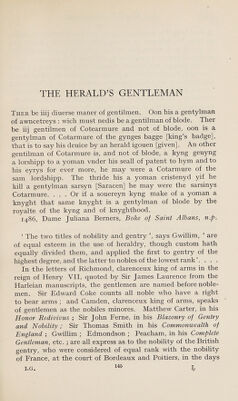
![Ther be iiij diuerse maner of gentilmen, Oon his a gentylman of awncetreys ; wich must nedis be a gentilman of blode. Ther be iij gentilmen of Cotearmure and not of blode, oon is a gentylman of Cotarmure of the gynges bagge [king’s badge], that is to sa}^ his deuice by an herald igouen [given]. An other gentilman of Cotarmure is, and not of blode, a kyng geuyng a lorshipp to a yoman vnder his seall of patent to hym and to his eyrys for ever more, he may were a Cotarmure of the sam lordshipp. The thride his a yoman cristenyd yif he kill a gentylman sarsyn [Saracen] he may were the sarsinys Cotarmure. ... Or if a souereyn kyng make of a yoman a knyght that same knyght is a gentylman of blode by the royalte of the kyng and of knyghthood. i486. Dame Juliana Berners, Boke of Saint Albans, n.p. ‘ The two titles of nobility and gentry ’, says Gwillim, ‘ are of equal esteem in the use of heraldry, though custom hath equally divided them, and applied the first to gentry of the highest degree, and the latter to nobles of the lowest rank ’. . . . In the letters of Richmond, clarenceux king of arms in the reign of Henry VII, quoted by Sir James Laurence from the Harleian manuscripts, the gentlemen are named before noble- men. Sir Edward Coke counts all noble who have a right to bear arms ; and Camden, clarenceux king of arms, speaks of gentlemen as the nobiles minores. Matthew Carter, in his Honor Redivivus ; Sir John Feme, in his Blazonry of Gentry and Nobility; Sir Thomas Smith in his Commonwealth of England ; Gwillim ; Edmondson ; Peacham, in his Complete Gentleman, etc. ; are all express as to the nobility of the British gentry, who were considered of equal rank with the nobility of France, at the court of Bordeaux and Poitiers, in the days 145 T. I.G,](https://iiif.wellcomecollection.org/image/b29008529_0163.jp2/full/800%2C/0/default.jpg)